

Quick Answer: ANSA Motors reported in August 2026 that hybrids are approximately 35% of its new-car purchases, roughly one in three. That shows buyers are moving toward hybrids, but not that any dealer has earned that demand. Buyers arrive in different stages of readiness, buy for different jobs, and do much of their research in Facebook groups, WhatsApp chats and AI tools before they meet a sales rep. Dealers that align marketing and sales around the buyer's journey, and answer the questions buyers are already asking, are the ones that turn growing demand into market share.
In August 2026, ANSA Motors reported that hybrids now account for approximately 35% of its new-car purchases in Trinidad and Tobago, alongside the launch of a new hybrid model. That figure is ANSA's own, not a national statistic. Even so, it raises a question that applies to every dealership in the market.
If roughly one in three new-car purchases at a major dealer is a hybrid, what does that mean for how cars are marketed, sold and followed up?
Is the hybrid market mature or still early?
Both, and the difference matters.
Hybrids are not new. Toyota, Honda and Nissan hybrids have been on Trinidad and Tobago roads for years, and newer brands have added their own. The technology has had time to earn some trust. What is still immature is the way the market buys and sells it. Buyers are still learning what a hybrid means for running costs, reliability and resale. Dealers are still mostly promoting vehicles rather than educating buyers about them.
That gap is easier to manage when you recognise that buyers are not one group.
Swipe sideways to see the full table on mobile.
| Buyer type | What drives them | What they need from the dealer |
|---|---|---|
| Curious, but staying on petrol | Familiarity and trust in what they know | Plain explanations, with no pressure to switch |
| Early adopters | Interest in the technology and confidence in the brand | Strong onboarding and customer success after the sale |
| Watchers | Wanting to see how others fare before committing | Real owner experience and honest ownership stories |
| Bridge buyers | A hybrid now, possibly electric later | A clear roadmap and reassurance about what comes next |
Two points about these groups are worth drawing out.
First, local culture shapes the watchers. A common instinct in Trinidad and Tobago is to let somebody else buy first and see how it goes. Those buyers are not ignoring the technology. They are waiting for evidence, and the early adopters supply it. That makes customer success with early adopters a marketing asset as well as a service obligation. How the first owners of a model are treated becomes the story the watchers hear.
Second, technology is easy to get caught up in. But a vehicle still has to do the job it was bought to do: be reliable and get someone from A to B with a good experience. Buying a car is an experiential sale, and the experience has to hold up long after the excitement of the new technology fades.
What job is the buyer hiring the vehicle to do?
People do not buy a powertrain. They buy a vehicle to do a job, and the job varies widely.
Swipe sideways to see the full table on mobile.
| Value proposition | Example buyer | What the message needs to show |
|---|---|---|
| Productivity | A travelling officer spending hours in traffic | Comfort, efficiency and reliability across long days |
| Profitability | A driver using the vehicle for taxi work | Running cost, servicing cost and uptime |
| Image | Someone who has just been promoted | Design, brand and how the vehicle reflects where they are |
| Convenience | A household tired of fuel stops | Home charging or fewer refuelling trips |
| Experience | A family buying for daily life | Comfort, safety and how it feels to own |
This is where a common assumption falls short. When ANSA's General Manager of New Vehicle Sales, Mark Pontifex, said consumers are looking for value, the natural follow-up is whose definition of value. A description of the typical buyer of one model is not an ideal customer profile. It is a starting point.
The more useful approach is to define ideal customer profiles by the job and the buyer, and then decide which models serve each one. That is a different question from hybrid versus electric. A single powertrain can serve several profiles, and a single profile can be served by several powertrains. Each profile needs its own message, its own proof and its own follow-up.
Where do buyers actually do their research?
Increasingly, outside the showroom and away from the sales rep.
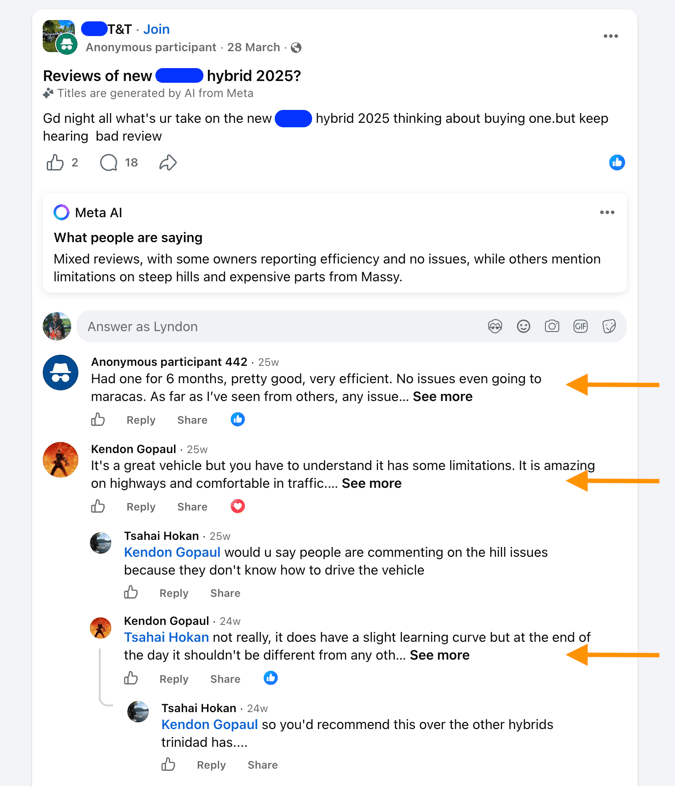
We looked at two public Facebook threads in local car groups, one from September 2025 and one from March 2026, both asking for opinions on a popular hybrid SUV. Together they have about 26 comments. It is a small sample and should be read as an illustration, not a statistic, but the pattern is instructive.
Swipe sideways to see the full table on mobile.
| What the buyer asks | What the threads show | What a dealer could publish |
|---|---|---|
| Is it reliable, and are the bad reviews true? | Mixed answers. Some owners report no issues after months of use, others advise caution | Reliability record, warranty terms and service history in plain language |
| What about the battery? | The original poster cites online reviews complaining of battery drain and reduced acceleration | How the hybrid battery works, what to expect over time, and what it costs to replace |
| Should I buy a full EV instead? | One commenter says a full EV avoids engine and transmission servicing, another warns hybrids wear the petrol engine through constant restarting | An honest hybrid versus electric comparison for local driving |
| What about parts and servicing? | Comments raise parts availability, price and the quality of agent servicing | Parts and service commitments, published up front |
| Can it handle our hills? | Steep-hill limitations come up, and one exchange debates whether it is the vehicle or a learning curve in how it is driven | A clear explanation of how the vehicle performs on hills and how to drive it |
| Is another model a safer choice? | One commenter recommends a different hybrid as a more mature system | Comparison content that treats competitors fairly |
The same thing happens in WhatsApp groups and among friends and family. This changes how a sales rep should read a quick close. When a sale closes in two weeks, it is often because the real decision was made earlier, in a group chat or on a Facebook thread the rep never saw.
Meta's AI also added a summary to both threads. One concluded that most recommend a full EV for better reliability. The other described mixed reviews, with limitations on steep hills and expensive parts. Buyers reading those summaries take a verdict away before they speak to anyone at a dealership.
That raises the question of ownership. Who is owning the information about hybrids and electric vehicles in this market? It does not have to be branded content. Any dealer, whatever they sell, could publish general, useful education about how hybrids and EVs work, what they cost to own and how to choose between them. Buyers are already looking for that information. Whoever supplies it earns the trust.
Are buyers using search and AI tools to compare?
The evidence suggests they are, and increasingly.
We ran the topic through AnswerThePublic for Trinidad and Tobago. Google search volume for the head term "hybrid vehicles" is low, about 140 a month. That is understandable, and it does not mean people are not researching. It suggests the research is moving elsewhere. The questions that do appear are specific: what the disadvantages of a hybrid are, how long one lasts, whether it is expensive to replace a battery, whether hybrids are reliable and expensive to maintain, and how a hybrid compares with an electric vehicle or a petrol car.
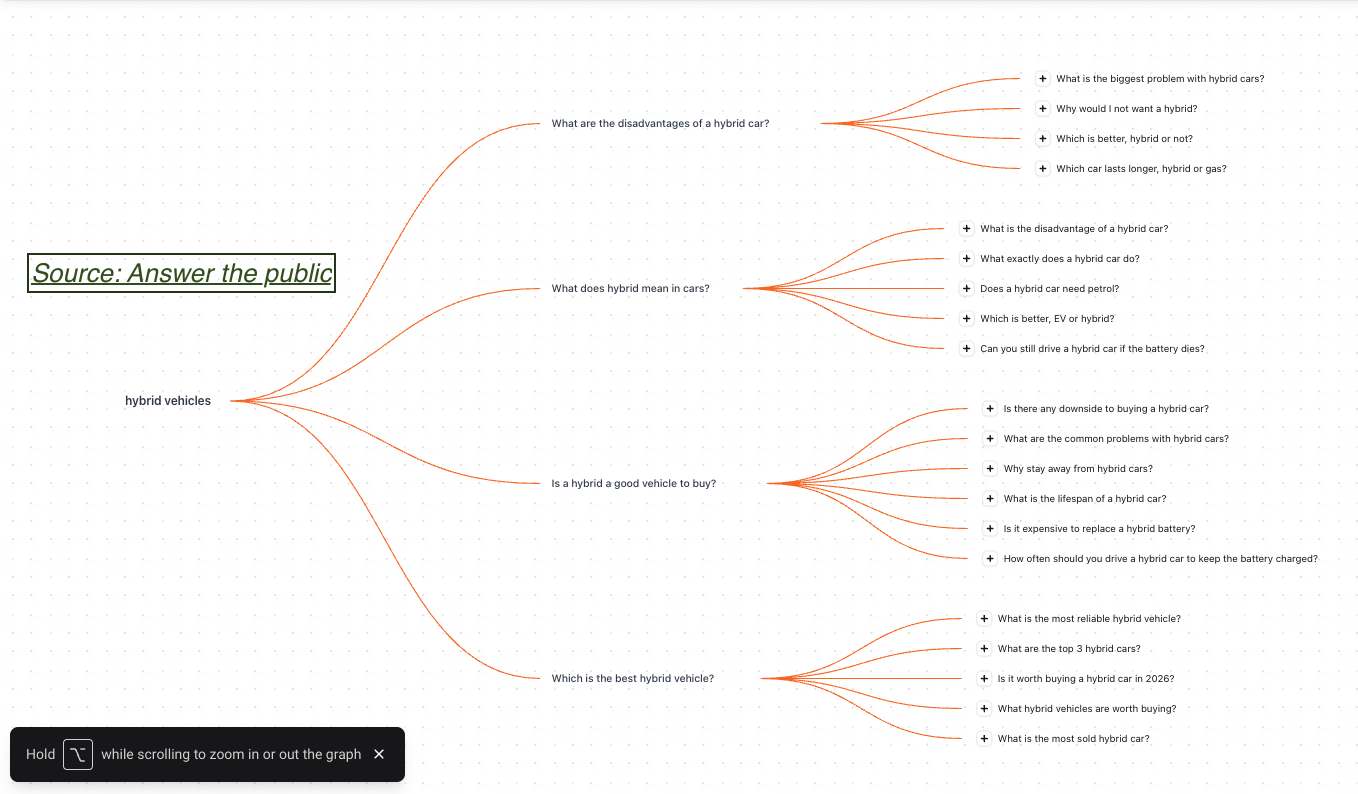 Search results tree: Answer the public
Simulated ChatGPT and Gemini prompts for the topic point the same way: which hybrids are available for sale locally, which dealerships offer them, where to find authorised servicing and battery replacement, and how to compare financing. These are modelled prompts, not measured behaviour, so they show the shape of the questions rather than how many people ask them.
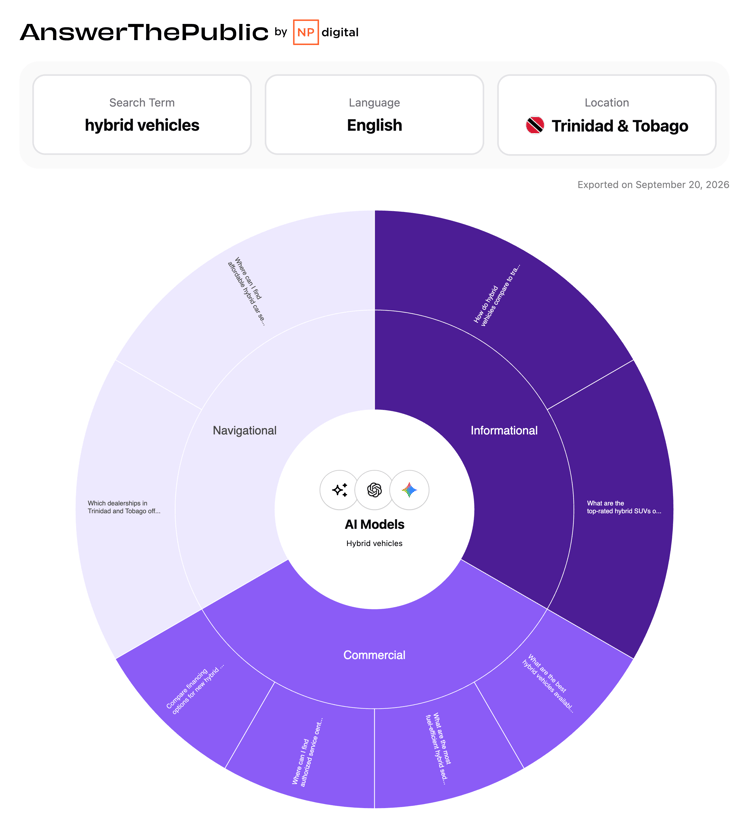
For a measured signal, US data helps. The Cox Automotive Car Buyer Journey Study, based on 2,300 buyers surveyed in fall 2025, found that about 25% of new-vehicle buyers used AI tools while shopping, and that 71% of buyers went in with an open mind, unsure which vehicle they would buy. These are US figures and should be read as a direction of travel, not a local measurement. But they point to a pattern: buyers ask an AI tool to do the comparison instead of reading many pages themselves, and they arrive with the shortlist still open.
A dealer that publishes clear, local answers is doing two things at once. It is educating the buyer, and it is becoming a source that search engines and AI tools can draw on.
How should sales and marketing align around the buyer's journey?
The buyer's journey is not a marketing document or a sales document. It is the shared map that lets each team know when it leads and when it hands over.
Swipe sideways to see the full table on mobile.
| Journey stage | What the hybrid buyer is doing | What marketing does | What sales does |
|---|---|---|---|
| Awareness | Reacting to fuel cost and wondering whether petrol-only still makes sense | Publishes clear, local education on hybrid ownership and answers common questions, including unbranded content | Stays visible and helpful in the channels buyers use, without hard selling |
| Consideration | Comparing hybrids, electric vehicles and older petrol options, often with an AI tool | Provides comparison content, owner stories and warranty and service clarity, and captures interest through forms and enquiries | Runs a proper discovery conversation (see below) and records what the buyer said |
| Decision | Weighing monthly payment, trade-in value and after-sales confidence | Supports with financing guides, trade-in tools and test-drive booking | Brings financing and total ownership cost forward, and follows up before the buyer moves on |
| Purchase | Confirming specification, safety and delivery | Keeps messaging consistent with what was promised | Keeps the process fast, clear and well documented |
| Ownership | Learning how the vehicle behaves and when it needs service | Shares practical ownership content | Customer success checks in early, especially with early adopters |
| Re-engagement | Reaching the point where the next vehicle becomes a live question | Nurtures owners based on ownership stage | Reaches out on the customer's cycle, not the dealer's campaign calendar |
The sales column depends on discovery. In our article on seven questions automotive reps should ask before presenting a vehicle, we set out a simple sequence: what are you driving now, what do you like about it and why did you buy it, how long have you had it, what do you like most and least, why are you looking, what is most important to you, and a recap to confirm alignment. Those questions still apply. For hybrid and electric buyers, a few more are worth adding: what do you spend on fuel today, have you considered a fully electric vehicle and what stopped you, do you have somewhere to charge, and what job is the vehicle doing for you.
Where does customer relationship management (CRM) strategy turn market change into a repeatable process?
Content and discovery only turn into share if the answers are captured and acted on. That is the work of customer relationship management strategy: deciding what to record about each buyer, and what should happen next as a result. Three decisions do most of the work.
First, capture each buyer's stance, the job they need the vehicle to do, and the profile they fit, as structured fields, not notes a rep may not read again. A buyer who is a watcher needs different follow-up from an early adopter.
Second, agree the handoff between marketing and sales, and make it visible. Marketing brings the buyer to a defined point, and sales picks up with the context intact. Without that agreement, marketing generates interest that sales cannot use and sales asks questions the buyer has already answered.
Third, treat existing customers as part of the story. Early adopters generate the proof that watchers are waiting for, and owners approaching the end of a finance term or ownership cycle are potential hybrid buyers the dealer already knows. This is the Engage stage we described in our earlier article on market share: the years between purchases, usually the least resourced stage, and the one a newcomer with better answers can win.
What does roughly one in three mean for dealers?
It means buyers are ready. What is still open is which dealership will be the one that explains it to them.
Demand growing across a market does not belong to any single dealer. Ownership comes from being the source a buyer trusts while they are still deciding, from marketing and sales working to the same map of the journey, and from customer success turning early adopters into the proof that everyone else is waiting for.
Key Takeaways
- ANSA Motors reports that hybrids are approximately 35% of its new-car purchases. This is ANSA's own figure, not a national statistic.
- Hybrids have been on the market for years, but the way dealers market and sell them is still maturing.
- Buyers fall into different types: those staying on petrol, early adopters, watchers and bridge buyers. Each needs something different.
- Customer success with early adopters matters because their experience becomes the proof that watchers wait for.
- People buy a vehicle for a job, such as productivity, profitability, image, convenience or experience. Ideal customer profiles should be built on those jobs, not on the powertrain.
- Much of the research and many of the decisions happen in Facebook groups, WhatsApp chats and AI tools, before a buyer meets a sales rep.
- Marketing and sales need a shared buyer's journey with clear handoffs, and customer relationship management strategy is what makes that repeatable.
FAQ
What percentage of new-car buyers in Trinidad and Tobago choose hybrids?
ANSA Motors reported in August 2026 that hybrids represent approximately 35% of its own new-car purchases. This is a company figure, not a market-wide statistic.
Are there different types of hybrid buyers?
Yes. Some buyers are curious but stay on petrol, some are early adopters, some wait to see how others fare, and some use a hybrid as a bridge to electric. Each group needs different information and follow-up.
How should marketing and sales work together on hybrid buyers?
Marketing builds awareness and supports comparison with education and proof, then hands buyers over at an agreed point with the context captured. Sales runs discovery, brings ownership cost and financing into the conversation, and follows up. Customer success takes over after the sale.
What should a sales rep ask a hybrid buyer?
Start with the standard discovery questions in our seven questions article, then add fuel spend, whether they have considered a fully electric vehicle, charging access and what job the vehicle needs to do.
How can a dealership own the hybrid conversation?
By publishing clear, local education on how hybrids and EVs work and what they cost to own, in branded and unbranded form, at the right stage of the buyer's journey, and by using customer relationship management strategy to follow up based on each buyer's stance and job.
Related reading
- Market Share Isn't the Same as Growth: A GTM Lesson from Trinidad & Tobago's Automotive Sector
- 7 Questions Automotive Reps Should Ask Before Presenting a Vehicle
- Pipeline vs Buyer Journey: What August Taught Me About the Gap CRM Doesn't Show
- CRM Maturity: The Caribbean's Next Competitive Advantage
Sources
- TTT News, "ANSA Motors Targets Growing Demand For Hybrid Vehicles In T&T", 23 August 2026
- Cox Automotive, Car Buyer Journey Study, January 2026 (US data)
- Engagent, "7 Questions Automotive Reps Should Ask Before Presenting a Vehicle"
- AnswerThePublic, keyword and AI-model research for "hybrid vehicles", Trinidad and Tobago, exported 20 September 2026
- Public Facebook group threads about a popular hybrid SUV, September 2025 and March 2026 (commenters and brand not named)
If you want to know whether your marketing and sales teams are working from the same buyer's journey, and whether your CRM captures what buyers tell you, that is a quick thing to check.
Happy to walk through it.

Share your thoughts