

Skip to content
77 min read

7 Questions Automotive Reps Should Ask Before Presenting a Vehicle

Some years ago, I lost a $150K deal because of a $5K missing piece of plastic.
 
Was it the fault of the product?  No, it was my fault because I did not ask the customer one simple question.
 
 
"What's important to you?" My years in the automotive industry have been eventful, rewarding and a great learning experience as a sales professional; however, that particular experience has stuck with me throughout my sales career.
 
Fast forward to today, and with my continued passion for automotive sales still burning inside me, I cannot help but notice that present-day automotive sales professionals are making the same mistakes I did many years ago.
 
A prospect walks into a dealership, expresses interest in a vehicle, and they go straight down the rabbit hole of demo mode.
 
I'm not one to see something wrong and not try to do something about it. So here are seven questions automotive sales representatives should ask customers before talking or engaging in specs, features, pricing, etc.

Editor’s Note (2026):
This article was originally written in 2021. While technology, AI, and CRM systems have evolved in dealerships, the core issue remains the same misalignment between what customers value and how sales professionals engage.

The seven questions below are still foundational to any high-performing automotive sales process.

What Questions Should Automotive Sales Reps Ask Before Presenting a Vehicle?

Automotive sales representatives should ask discovery-focused questions before discussing features or pricing. These questions help uncover the customer’s current vehicle situation, motivations for change, financial timing, emotional drivers, and most important buying criteria.

The seven foundational questions are:

  1. What are you driving now?
  2. What do you like about it, and why did you initially purchase that model?
  3. How long have you had it?
  4. What do you like most or least about your current vehicle?
  5. Why are you looking now?
  6. What’s most important to you?
  7. The recap question.


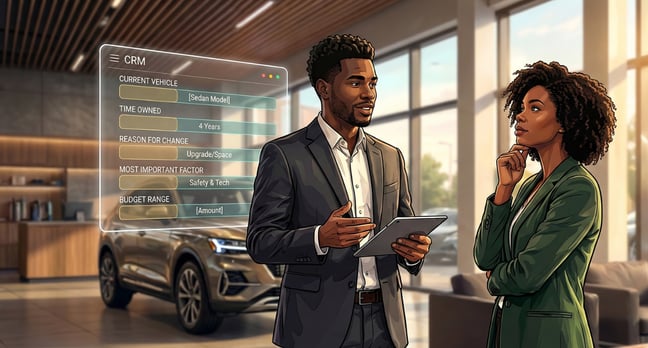
A graphic novel-style illustration of a Black male car salesman in a suit with a tablet talking to a Black female customer in a green jacket at a modern car dealership. A holographic CRM screen displays customer information between them, with a car in the background.

1) What are you driving now?

As a consultant, I would always recommend you start with the current state. This gives you an idea of the customer, provided you have created a customer profile for each vehicle/brand type.


2) What do you like about it, and why did you initially purchase that model?

This question gives you further background into the customer mindset. Some customers are emotional/impulsive buyers, while others are more practical buyers.
 
The practical buyers normally come from those who have the role of travelling officers or are making a purchase on behalf of a company. We will get into the B2B side of things in part two of this article.


3) How long have you had it?


This is a time‑gauge question that helps you determine how soon the prospect is likely to consider a change. For most buyers, the timing is anchored to their existing loan term. Historically, many financial institutions structured vehicle loans over five (5) years.

Over the last three (3) years, however, rising foreign exchange rates and increased Motor Vehicle Taxes (MVT) have driven list prices up significantly. As a result, standard loan terms have commonly shifted closer to seven (7) to eight (8) years.

Based on the customer’s answer, you can quickly gauge whether they are approaching the end of a five‑ or seven‑year term. This gives you a more accurate signal that they are genuinely in the market, actively evaluating options, and at a realistic point in their decision cycle.


4) What do you like most & least about your current vehicle?

Here is where you start digging a little deeper into their likes or dislikes. As technology, specs, features, bells & whistles change so has the customers. Some customers may give you a snapshot as to what is important to them now especially if anything changed their lives over the last five (5) years.


5) Why are you looking?

Based on how well you've been listening, you may not even have to ask this question, as you may have already discovered the reason. Asking the question is good for validation, and there are many different reasons why people purchase vehicles.
 
Here are just a few;
 
  • New job with/without car package
  • A new addition to the family
  • The family got smaller (bigger car no longer needed)
  • Son/daughter is a new driver
  • Was previously in an accident, the vehicle is written off/totalled
  • The customer is road safety-conscious
  • Change in job/personal activity (e.g. picked up off-roading on the weekend)
  • The warranty is almost up
  • Problems with the previous dealership, so looking for a new vendor
  • Something with a lower monthly instalment
  • Better overall total cost of ownership (TCO) 
These questions trigger responses that will give you a lot of leverage on how to position your sale. The key to picking up on this is being an active listener and proficient in asking more questions when you don't get the answer you may be looking for.


Also Read Article: “FINDING THE INFLUENCER” The Users


6) What's most important to you?

This is where you are basically asking the customer to shortlist all the things they like about a certain vehicle into one or two specific features. This gives you the ability to zone in on what will push them to the closing stage once those specific criteria are met.
 
If the customer says reliability, then you get the opportunity to speak on how reliable your recommendation is and its value to their reason for purchasing. Keep in mind that some customers may choose the credibility of the dealership and how they do business. So in this instance, there is no need to talk about the car but about your after-sales service.


7) The Recap Question:

Selling is about discovery, even if the customer walks into the showroom and expresses an interest in one of your vehicles, it's your responsibility to make sure they are looking at this for all the right reasons. You don't want to try to close a deal on a sedan when they really need a SUV. That's a misaligned sales approach to the customer and the potential for you to lose the deal for the sales rep.
 
Take the time to ask these questions, make up some more questions on your own, practice asking with your sales managers, team lead or teammates so that you get better at it and give the customer an exceptional consultative experience.


From Showroom Discovery to CRM Strategy

In modern dealerships, these discovery questions should not live only in the salesperson’s head. They should be reflected in structured CRM workflows, qualification stages, playbooks, and follow-up processes.

When discovery is documented properly, dealerships reduce friction, increase alignment, and improve conversion across the pipeline.

 

avatar
Founder | Lead Consultant | Father

COMMENTS