

What is Customer Relationship Management?
Customer Relationship Management is the strategy, processes, behaviours and systems a business uses to attract, understand, serve and retain customers. CRM software supports that discipline, but it does not create it.
What Customer Relationship Management Really Means
Customer Relationship Management (CRM) is the strategy, processes, behaviours and technology a business uses to attract, engage, serve and retain customers throughout their journey.
The software itself is only one part of the equation.
Many organisations invest in platforms such as HubSpot expecting the technology to solve problems automatically. In reality, a CRM software can only support the way a business already operates. If sales processes are unclear, customer data is inconsistent, or teams are working in silos, implementing new software will simply make those issues more visible.
A successful CRM strategy begins with understanding how the business creates value for its customers. It defines how leads are qualified, how opportunities move through the sales process, what information must be captured, who is responsible at each stage, and how success will be measured. Only then should the technology be configured to support those objectives.
The easiest way to view CRM is through three complementary perspectives:
1. Operational CRM
Operational CRM focuses on the day-to-day activities that keep customer relationships moving forward. This includes capturing enquiries, assigning leads, managing sales opportunities, automating follow-up, supporting customer service and ensuring teams have the information they need to do their jobs effectively.
2. Strategic CRM
Strategic CRM aligns customer interactions with the organisation's wider business objectives. It defines the customer journey, identifies the ideal customer profile, establishes qualification criteria, and ensures that marketing, sales and service teams are working towards the same outcomes.
3. Analytical CRM
Analytical CRM transforms customer and operational data into meaningful business insight. It enables organisations to understand pipeline performance, identify revenue leakage, measure customer lifetime value, monitor team performance and make informed decisions based on evidence rather than assumptions.
When these three areas work together, CRM becomes far more than a database. It becomes the operating framework that helps an organisation build stronger customer relationships, improve operational efficiency and generate sustainable revenue growth.
In a future article, we'll explore each of these three areas in greater detail and explain how they work together to create a modern revenue engine.
This article is about what should happen before the platform is touched, and what needs to change if the platform is already in place and underdelivering. The answer is the same in both cases: strategy and process before software.
-------------------------------------
If Your CRM Is Already Not Working, Read This First
Some businesses I work with are not new to CRM, but six months to two years in, something is clearly off. Activity is inconsistent, the pipeline no longer reflects reality, leadership stops trusting the reports, and deal status becomes unclear. In those cases, the problem is rarely the software. More often, the CRM is exposing strategy and process gaps that existed before implementation. A new platform can create a brief sense of order, but if the operation stays broken, the gap between appearance and reality soon shows, and the implementation gets blamed.
---------------------------------------------
|
Insight: If your CRM is underperforming, the audit should start with the operation, not the platform. In most cases, what looks like a configuration problem is actually an ownership, process, or data discipline problem. Fixing the settings will not resolve it. Fixing the operation will. |
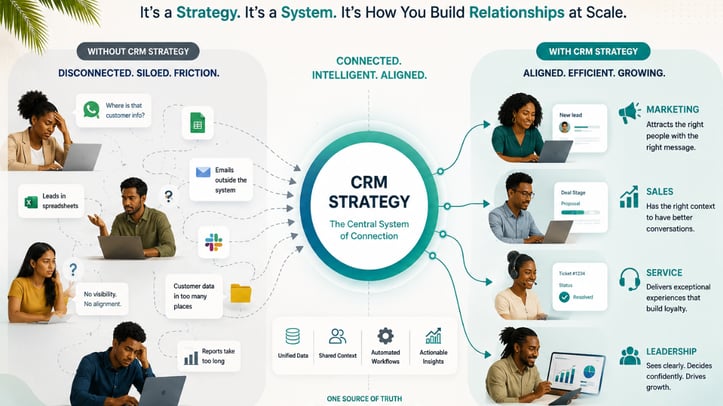
When an organisation with unclear processes, inconsistent follow-up, and customer knowledge scattered across WhatsApp threads installs a CRM, what they get is a more expensive version of the same problem. The dysfunction is now digital.
I have seen it play out more times than I care to count. A business invests in a platform, spends weeks on configuration, and six months later the CRM is either not being used properly or has become a graveyard of outdated contacts and half-completed deals. Leadership concludes that CRM does not work for businesses like theirs. In reality, CRM failed because the foundation was never built.
What Customer Relationship Management (CRM) Actually Is.
CRM is the structured management of customer relationships across the entire customer lifecycle in order to maximise long-term mutual value.
-
It is strategic
-
It is cross-functional
-
It is lifecycle-oriented
-
It is Customer-centric
-
Most Importantly, it is revenue-connected.
Overall, It is how an organisation thinks about, designs, and operates its relationships with the people it serves.
Software, whether that is HubSpot, Salesforce, Zoho, or anything else, is the operational layer that supports the strategy. It is where the strategy runs, but it is not the strategy itself.
This distinction matters enormously in practice. Organisations that understand CRM as a strategy, design their customer journey before they configure a pipeline. They define lifecycle stages before they build automation. They clarify ownership and accountability before they set up workflows. Then they use the platform to make those decisions visible, consistent, and scalable.
Organisations that understand CRM as software do the opposite. They configure first and think later. They automate before they have standardised the process being automated. They add contacts before they have decided what to do with them.
|
Insight: The strategy exists before the software. Any organisation that begins with software configuration before establishing people, process, and strategic intent is building on an unstable foundation. At Engagent, we do not begin any HubSpot engagement without first understanding the operational model we are building it on. |
The Sequence That Changes Your Perspective
There is a principle I return to in every client engagement, regardless of industry, geography, or team size. It is deceptively simple.
This is not a preference or a consulting philosophy. It is the correct sequence for building anything operational that involves human beings. Technology should support operational maturity, it should not attempt to create it.
What does this look like in practice? It means that before a single workflow is built, before the first pipeline stage is created, before a single contact is imported, the following questions need to have real answers.
-
Who owns the customer relationship at each stage of the lifecycle?
-
What does the handoff from sales to onboarding look like, and who is responsible for making sure it happens cleanly?
-
How does the organisation define a qualified lead, and is that definition shared across every team member who interacts with prospects?
-
What does a successful customer onboarding look like, and how do you know when it has been completed?
These are people and process questions. They have nothing to do with software. And yet most organisations cannot answer them clearly before they start their CRM implementation.
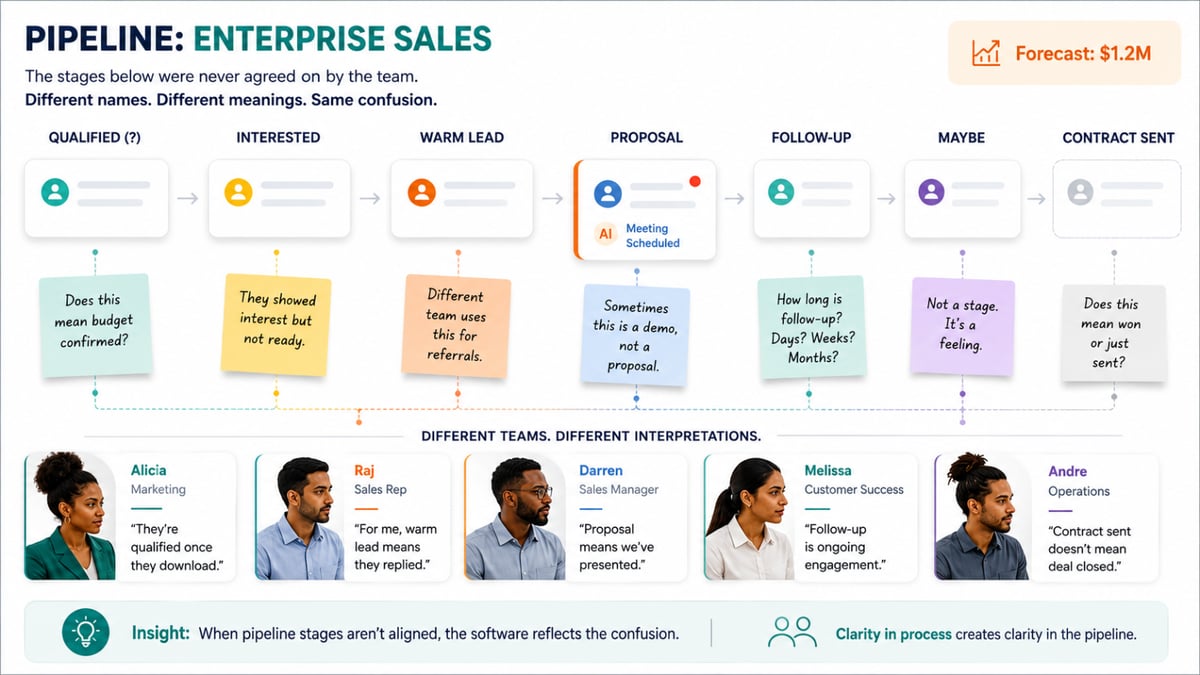
When the sequence is wrong, when technology is introduced before people and process are aligned, the platform absorbs and reflects whatever dysfunction already exists. Inconsistent follow-up becomes inconsistently logged activity.
Unclear ownership becomes unassigned contacts. Poor handoffs become broken workflows. The CRM does not fix these problems. It makes them visible in a way that is harder to ignore, which is useful, but only if the organisation is prepared to address what it finds.
Force and Friction: A Practical Lens
One of the frameworks I use in consulting work is something I call Force and Friction. It is a straightforward diagnostic lens that applies to any customer-facing operation.
Force is anything that moves a customer relationship forward.
-
Trust
-
Clarity
-
Responsiveness
-
Confidence
-
Convenience
-
Consistency
When an organisation scores well on these, customers move through the lifecycle smoothly, from awareness to enquiry to commitment to retention.
Friction is anything that slows down, damages, or blocks that movement.
-
Delays
-
Unclear processes
-
Slow or Poor communication
-
Inconsistent handoffs
-
Onboarding confusion
-
Operational silos
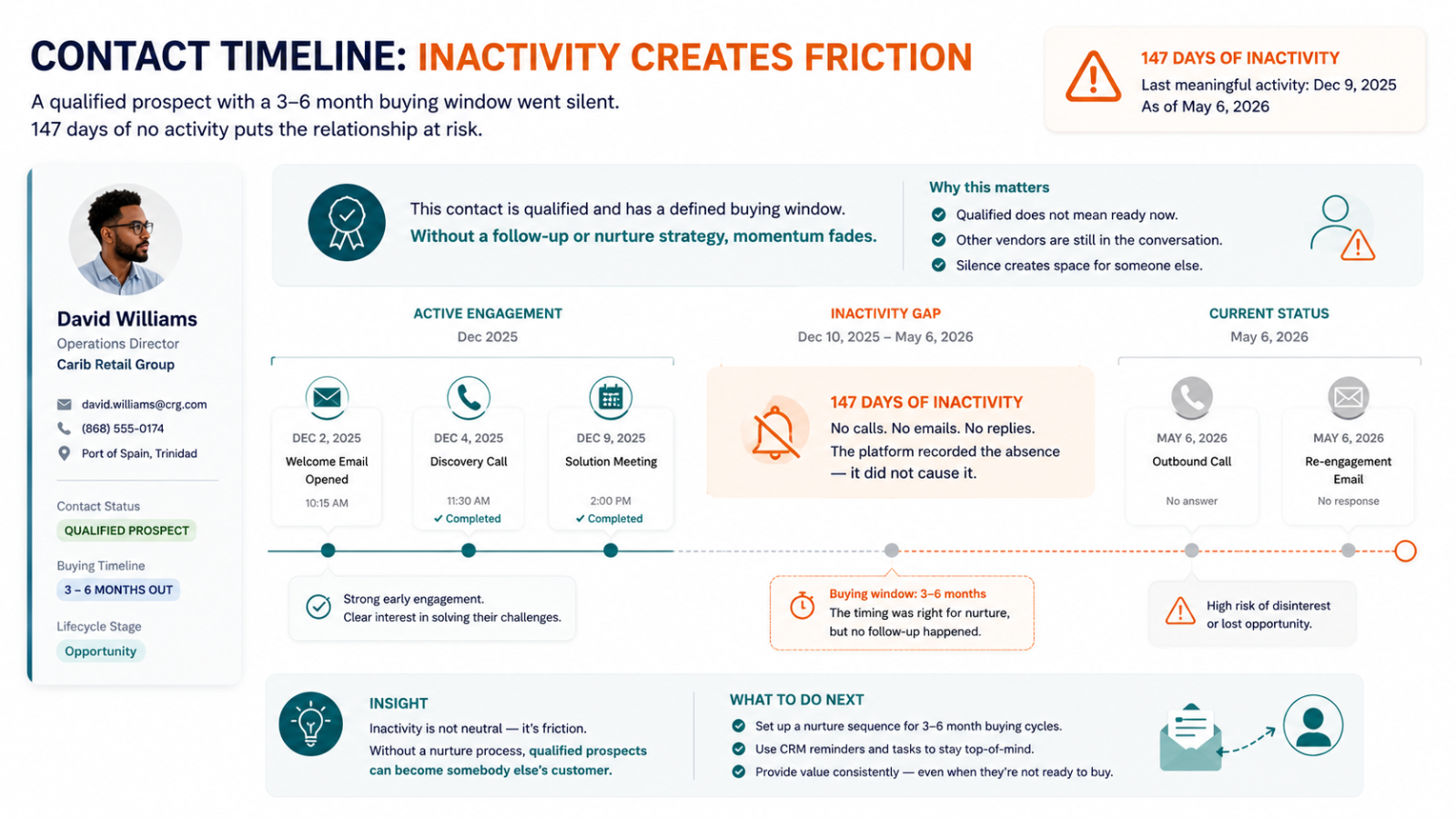
When friction is present, customers feel it, even if they cannot name exactly what is wrong. They feel the confusion when no one follows up. They feel the gap when they have to re-explain their situation to a new team member who was never briefed. They feel the uncertainty when they do not know what happens next.
|
Insight The most common friction sources I encounter in mid-market and growing businesses are weak follow-up discipline, WhatsApp conversations that never make it into the CRM, unclear handoffs between sales and service, and customer knowledge that lives in people's heads rather than shared systems. These are people and process failures, not technology failures. A CRM does not create them and cannot cure them. |
The objective of CRM strategy is to design and operate a system that increases Force while reducing Friction across every stage of the customer lifecycle. That design work ideally should happen before the platform is touched. The platform is where the design is implemented.
When I audit a client's CRM, I am not primarily looking at what has been configured in the software. I am looking at whether the underlying operation has enough Force to sustain the customer relationships it is trying to manage. Most of the time, the friction is obvious before I have opened a single report.
The Five Maturity Levels
Not every organisation starts in the same place, and not every organisation needs to reach the same destination. What matters is understanding where you are, so you can make informed decisions about where to go next.
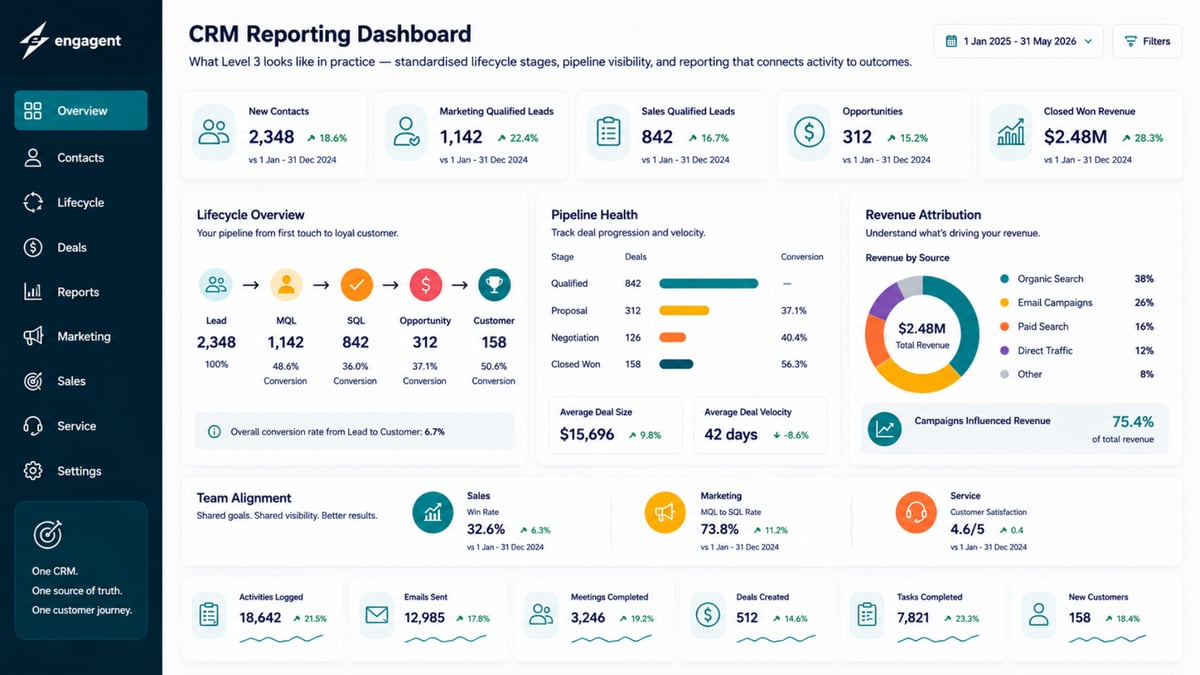
I evaluate CRM maturity across five levels. Most businesses engaging with CRM for the first time, or revisiting a failed implementation, are operating somewhere in the first two.
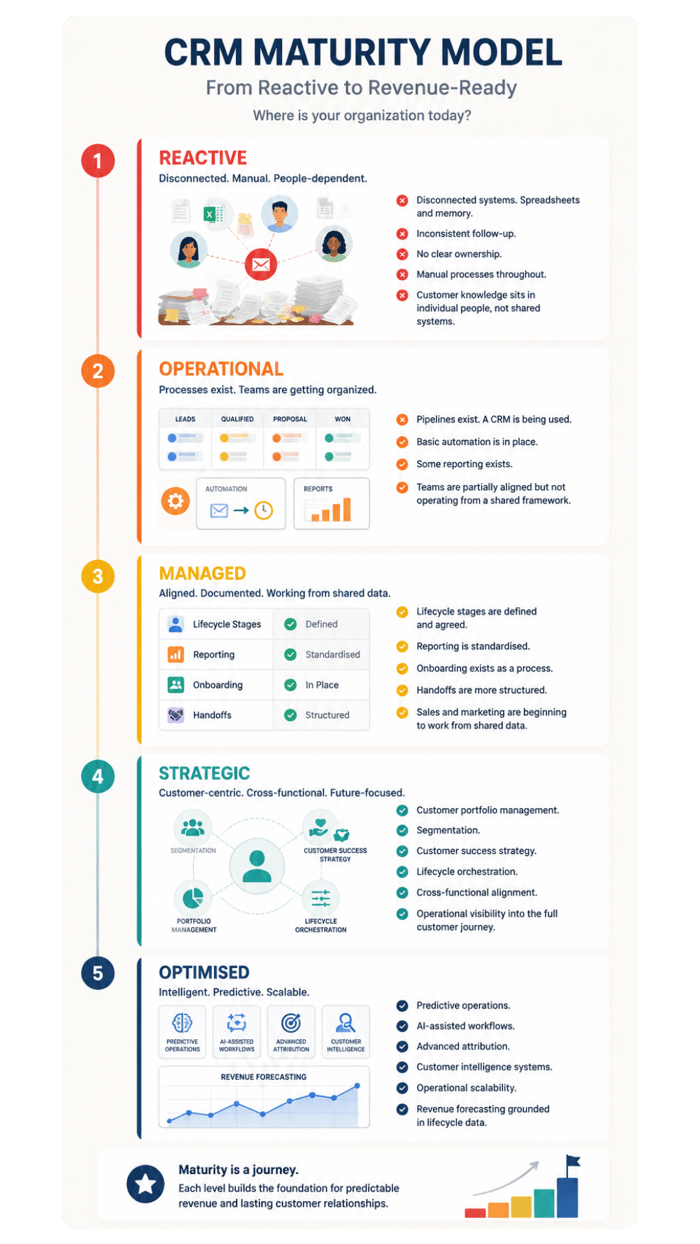
The goal of most initial engagements is not to reach Level 5. It is to move from Level 1 to Level 2 with the right foundations, or from Level 2 to Level 3 with clarity and intention. Each progression requires operational work before platform work.
What This Means for Your Business
If you are considering a CRM implementation, or wondering why a previous one did not deliver what you expected, the most useful question to ask is not which platform to use. It is this: do we have the operational clarity to support a CRM?
That means asking whether your team has a shared understanding of the customer journey. Whether you know who owns the relationship at each stage. Whether your follow-up is consistent enough to be automated without amplifying inconsistency.
Whether your customer knowledge is documented anywhere, or whether it lives in a WhatsApp group and the memory of your most experienced team member.
If the honest answer to most of those questions is no, that is not a reason to delay. It is a reason to start with strategy before software. To define before you configure. To build the operational foundation that makes the platform worth deploying.
A CRM should make a good operation more visible and more scalable. It will not make a struggling operation suddenly work. That is a job for the strategy, the process design, and the people who need to operate it.
|
Insight: This is the core positioning Engagent was built on: CRM maturity is operational maturity. The platform follows the strategy. Organisations that reverse this sequence invest in technology that amplifies dysfunction rather than enabling growth. |
Where to Start
The most practical starting point for any organisation approaching CRM, for the first time or the second, is an honest readiness assessment.
-
Not a software demo.
-
Not a pricing comparison.
An assessment of where your operation actually is, what gaps exist in your customer journey, and what needs to be resolved before a platform will help rather than hinder.
We built a self-serve CRM Readiness Assessment specifically for this purpose. It takes between five to ten minutes to complete, covers five core areas of your customer operation, and gives you an immediate maturity level with a breakdown by category. No contact details required to see your results.
If you are planning a CRM implementation in the next six months, or if you are trying to understand why your current CRM is not delivering what you expected, it is a useful place to start.
|
Take the CRM Readiness Assessment Score your organisation across five categories, Strategy, Sales and Acquisition, Lifecycle and Handoffs, Data and Visibility, and Post-Sale Retention. Get an instant maturity level and a breakdown of where to focus. No sign-up required to see your results. Start the assessment at engagent.io/crm-readiness-assessment → |
Comments