

Introduction
Every sales leader is chasing the same outcome: revenue that behaves predictably, quarter after quarter, without burning time on work that doesn’t move deals.
At the start of 2026, the serious conversations were about diagnosis — where, specifically, performance breaks down in your revenue system — before anyone went shopping for new tools or redesigning playbooks. That hasn’t changed. What has changed is the cost of skipping that diagnostic step.
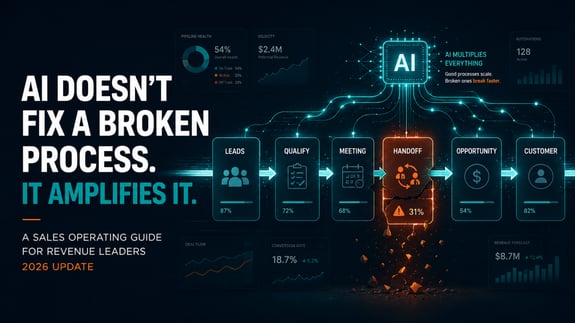
Across the teams I’ve been in with this year, the first half of 2026 has been about pushing AI into the tech stack. Agents drafting follow-ups, scoring leads, summarising calls, even initiating outreach sequences. And the pattern is now obvious. AI doesn’t repair a broken system. It amplifies whatever’s already there.
A CRM with poor hygiene and vague definitions doesn’t become clearer with an AI layer on top — it just makes confidently wrong decisions faster and at greater scale. A pipeline with fuzzy stage criteria doesn’t become more rigorous because you’ve added an AI dashboard — it just produces more polished, more persuasive, but still inaccurate forecasts.
So the diagnostic questions from earlier this year are now more urgent, not less. The underlying framework still holds — that’s the operational architecture you need. What’s new, and what this update focuses on, is where AI is exposing gaps you thought you could live with, and where it’s quietly creating new ones in how leads move, how reps behave, and how leadership reads the numbers.
----------------------------------------
In This Guide
- Sell Better: Fix the Structural Gaps (Updated for AI-Era Visibility)
- Sell Faster: Remove Operational Drag (Updated for AI-Assisted Workflows)
- New: What AI Changed Between the Start of 2026 to Now
- The Pattern Behind Revenue Leaks
- Diagnose Before You Invest Again
Sell Better: Fix the Structural Gaps
The four structural gaps from earlier this year are still the right diagnostic lens. What's changed is what's visible now that AI tools are layered on top.
1. Reps Are Flying Blind Into Conversations — Now Buyers Are Ahead, Too
This was already true in January: prospects do their research before your reps ever speak to them.
By mid-2026, that gap has widened. Buyers are using AI to research vendors, compare options, and come into conversations with sharper, more specific questions — often more informed about your category than the rep sitting across from them.
If your team’s only visibility into prospect behaviour is still “did they open the email,” the credibility gap isn’t just unaddressed. It’s wider than it was six months ago.
What fixes this: the original answer — a single view of prospect activity — still stands. The question to ask now is: is that view actively feeding how reps prepare, or is it just sitting in a dashboard nobody opens before a call?
2. Deals Quietly Fall Through the Cracks — Or AI Is Quietly Mishandling Them
The follow-up problem hasn't gone away. But many teams have now bolted AI-driven follow-up sequences onto a process that was never clearly defined.
The result: automation that's technically "working". Yes, emails are going out — but you're reinforcing the same inconsistency that existed before, just faster and with less human oversight to catch it.
What fixes this: Same as before, map the follow-up structure (the process) before automating it. If you automated first, this is the moment to go back and check: is the AI following a defined process, or improvising one?
3. The Pipeline Looks Healthy — But AI Forecasts Make It Look Healthier
Vague stage definitions have always been a problem before. Now, AI-generated forecasts and pipeline scoring can make an unhealthy pipeline look more credible — confident percentages and projections built on the same loose "qualified" criteria as before.
What fixes this: Define entry/exit criteria per stage — this was true at the start if 2026 and remains the fix today. The new urgency: if AI is now scoring or forecasting off this pipeline, bad definitions don't just create confusion, they create false positives, which creates poor confidence in the tool(s)
4. The Sales Process Lives in Someone's Head — and AI Can't Learn What Was Never Written Down
This is the gap that's changed the most. Several teams have tried to use AI to "scale" what their top performers do, only to find there's nothing documented to scale from.
What fixes this: Documenting the real process was always the fix. Now there's a second reason to do it: it's the difference between AI tools that genuinely support your team and ones that produce generic, unhelpful output because they have nothing specific to work from.
Sell Faster: Remove Operational Drag
5. The CRM Slows Reps Down — Now It's Also Feeding (or Starving) AI
The CRM-as-a-burden problem from February hasn't disappeared. But there's a new dimension: your CRM is now also the data source for whatever AI tools you've adopted. A poorly configured CRM doesn't just frustrate reps, it limits what AI can actually do for them.
What fixes this: Same foundation as before — design around how reps work, automate the repetitive and cut unnecessary fields/properties/tags. The payoff is now twofold: better rep experience, and better AI output.
6. Sales Content Is Scattered, and AI Can Surface the Wrong Version Fast
Scattered content has always been a time drain. When decks, one-pagers, and messaging live in ten different places, reps spend more time hunting than selling.
Add AI on top of that and the dysfunction changes shape. If reps (or AI agents) are pulling from outdated decks or retired templates, inconsistency doesn’t just slow things down — it gets surfaced, reinforced, and repeated at speed.
That’s not AI “going wrong.” That’s your content architecture showing up in the outputs.
What fixes this: centralising sales content was always the answer. What’s different now is the cost of not doing it. An AI assistant pulling from your content library is only as effective as what you’ve put in that library. How current it is, how clearly it’s structured, and how easy it is for the right version to win every time.
7. Prospect Qualification — Now With AI Doing the First Pass
Many teams have now handed the first pass of qualification to AI, scoring, routing, even pushing leads into sequences. On the surface, it looks efficient.
But if you never defined your ICP clearly, all that happened is the guessing moved from humans to a model. The criteria are still vague. The decisions just look more confident.
That’s not “AI-powered qualification.” That’s automated ambiguity.
What fixes this: defining the ICP operationally, by behaviour, buying structure, and deal mechanics, not just industry labels, was the February fix and it’s still the prerequisite. The question to ask is: could someone who doesn’t know your market read your ICP and make the same qualification call as your best rep?
Until the answer is yes, AI-led qualification is just producing faster, more polished wrong answers.
8. No Single Source of Truth — Now It's an AI Reliability Issue
This started as a responsiveness problem. Leads sitting in different inboxes, channels not connected, nobody quite sure who owned what.
Now in June 2026, it’s also an AI accuracy problem. When data is fragmented, any AI you put across your stack is working with a partial view and confidently acting as if it isn’t. It won’t raise its hand and tell you what it can’t see.
That’s not AI “underperforming.” That’s your data architecture limiting what it can reasonably get right.
What fixes this: a centralised operating environment was already the answer in February. The distinction now is sharper — it’s no longer just about faster handoffs, it’s the precondition for AI tools to be trustworthy rather than merely fast.
What AI Changed Between January 2026 and Now
The honest summary of the last several months is straightforward: AI didn’t create new problems in most sales organisations. It took the dysfunction that was already there and made it move faster, with outputs that look more credible on the surface.
The teams that have actually benefited aren’t the ones that rushed AI into every workflow. They’re the ones that had already done the structural work, defined stages, documented process, real ICP, clean CRM hygiene, before they asked AI to operate inside that architecture. For everyone else, AI has mostly added speed and polish to gaps that were already costing them.
That’s not a signal to slow down on AI adoption. That’s the signal that the diagnostic work is the prerequisite. Not a nice-to-have in parallel.
The Pattern Behind Revenue Leaks
Every gap outlined above follows the same structure: what looks like a people or technology problem is almost always a process and clarity problem underneath.
Three questions before investing — now with one addition:
- Where is revenue actually leaking, based on data, not assumption?
- Is this a people, process, or technology gap, or a combination?
- What is the smallest structural change that creates measurable lift?
- (New) If we add AI here, does it amplify something that's already working — or something that's already broken?
Diagnose Before You Invest Again
The questions from February still stand:
- How many leads enter your pipeline monthly?
- What is your conversion rate at each stage?
- Where do deals most commonly stall?
- What is your average sales cycle length?
- Are these numbers measured — or estimated?
One more, for mid-2026: If you've added AI tools since February — has anything actually improved, or has it just gotten faster at producing the same results?
---------------------------------------------
Work With Engagent
Engagent helps organisations identify and close revenue gaps across People, Process, and Technology — and now, very specifically, where AI fits into that architecture without becoming another layer of complexity on top of unresolved dysfunction.
We don’t lead with software. We don’t lead with training. We lead with diagnosis.
If you’d like to see where revenue is actually leaking in your system — with or without AI in the picture — we can schedule a short, structured diagnostic conversation.
Book a Diagnostic Conversation →

COMMENTS