

What does it mean when a sales rep has more meetings but generates less pipeline?
When meeting activity increases but pipeline value drops, it signals a conversion problem, not an effort problem. The sales funnel is leaking at one or more stages. More meetings without addressing those leaks accelerates revenue loss. The fix is diagnosing exactly where in the funnel conversion is breaking down, and addressing the root cause at that specific stage.
The Number That Should Stop Any Sales Manager
I was reviewing a sales rep's results for the month of May recently, and one comparison stopped me immediately.
Sixteen meetings in May. Twelve meetings in April. A 33% increase in activity — on paper, a productive month.
Pipeline created in May: TTD 5,000. Pipeline created in April: TTD 31,000.
That is an 83% collapse in pipeline value on the back of a 33% rise in meeting activity. More effort. Dramatically less output.
When most sales managers see a gap like that, the instinct is to look at the rep. What were they not doing? Where did they fall short? That instinct is understandable — and almost always incomplete.
The better question is not "why didn't the rep do more?" The better question is: where exactly did the revenue go, and at which stage did the funnel break?
That is what this article is about.
Why Pushing on Activity Can Make the Problem Worse
Question: Why does more sales activity not always produce more revenue?
Answer: Because activity measures inputs, not outputs. When you increase meeting volume without understanding your funnel, you send more people through a process that is already leaking. The visible numbers improve. The revenue does not.
Far too often in sales leadership, the response to a slow month is to push harder on activity. More calls. More meetings. More motion. I understand the logic, numbers are tangible, activity is visible, and it feels like something you can control.
But volume does not always represent value.
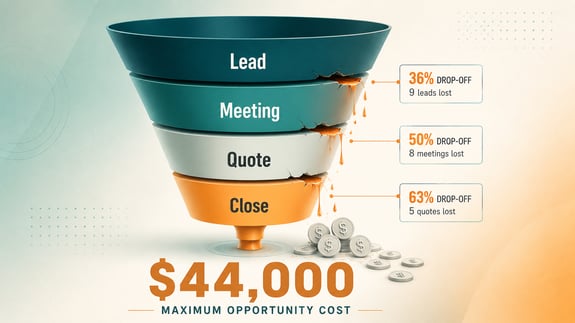
If nine out of twenty-five leads are dropping off before a meeting even happens, booking more meetings does not fix the problem at the top of the funnel. If half of your meetings are not generating quotes, increasing call volume does not improve your meeting-to-proposal conversion. You are not filling the pipeline. You are filling a leaking bucket faster.
This is what we refer to at Engagent as a Force vs Friction imbalance. The force — activity, effort, motion, is increasing. But the friction inside the funnel is absorbing it before it converts to revenue. Until you identify and remove the friction, adding more force produces diminishing returns.
→ Read more about the Force vs Friction framework
What the Funnel Actually Showed
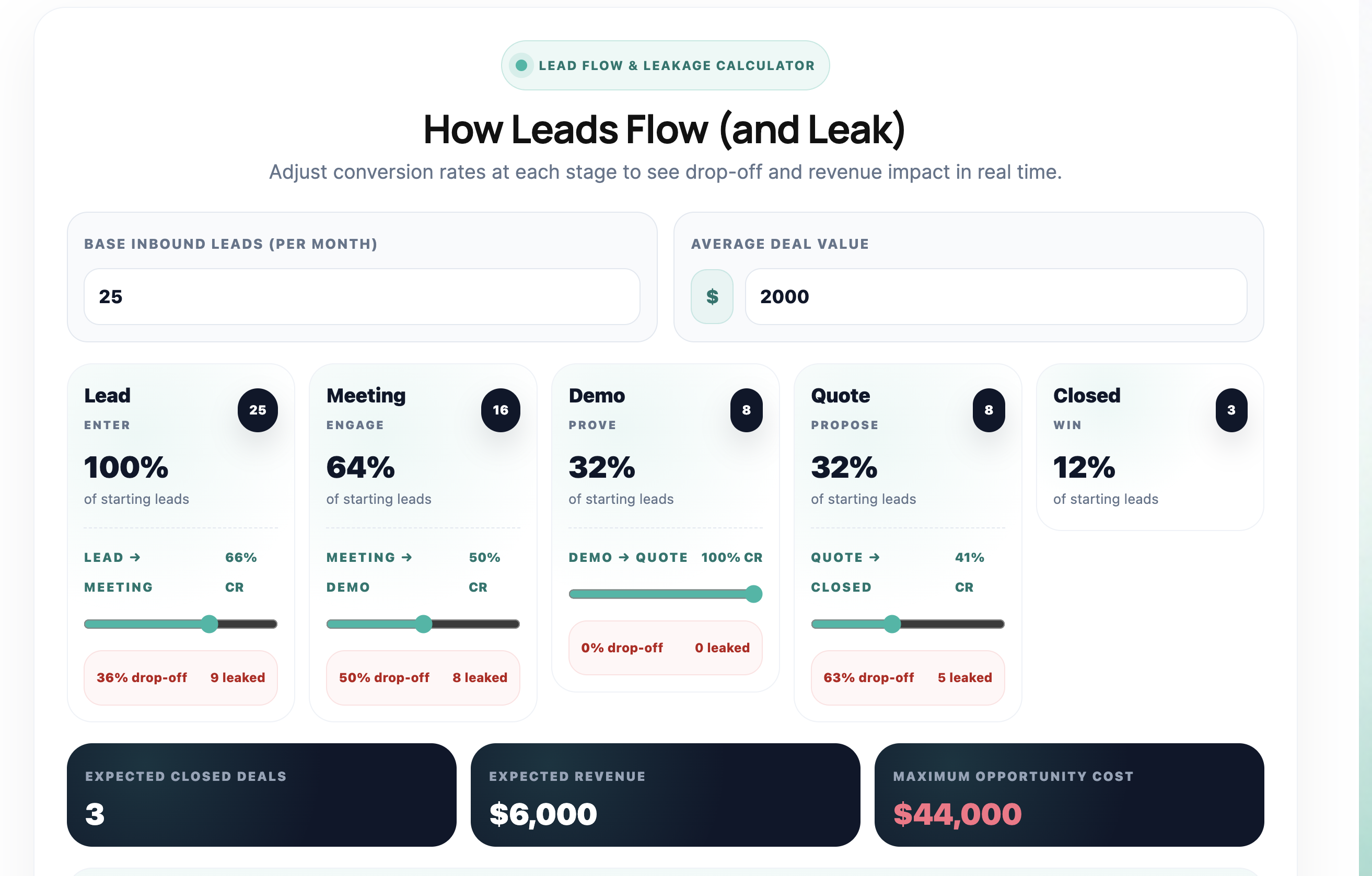
To understand where the pipeline went in May, I ran the scenario through the Engagent Lead Flow and Leakage Calculator. A tool built specifically to help sales managers visualise drop-off at each stage of their funnel and quantify the revenue impact.
Working with 25 inbound leads and an average deal value of $2,000, here is what the model revealed:
Stage 1: Lead to Meeting: 36% Drop-Off, 9 Leads Lost
Twenty-five leads came in. Sixteen made it to a meeting.
Nine prospects dropped off before a single conversation happened. Before the rep had a chance to qualify anyone, more than a third of the potential opportunity had already gone cold. This is the largest single leak in the funnel — and the one that is most often invisible in a standard activity report.
Stage 2: Meeting to Quote: 50% Drop-Off, 8 Leads Lost
Sixteen meetings were held. Eight generated a quote.
Half of the people the rep sat down with did not progress to proposal stage. That points to one of three problems: qualification discipline, discovery quality, or next-step commitment. You cannot know which one it is until you look at the individual meetings — which is exactly the conversation to have in a one-on-one review.
Stage 3: Quote to Close: 63% Drop-Off, 5 Leads Lost
Eight quotes went out. Three closed.
A 63% drop-off at the final stage. The rep reached proposal with eight prospects and converted fewer than half. At this stage, the gap is almost always a decision-making, pricing, or follow-up problem.
The Total Cost
| Metric | Figure |
|---|---|
| Leads entered | 25 |
| Meetings held | 16 |
| Quotes generated | 8 |
| Deals closed | 3 |
| Expected revenue | $6,000 |
| Maximum opportunity cost | $44,000 |
That $44,000 is not a projection. It is the gap between what the pipeline could have been worth at full conversion and what it actually produced. It is the measurable cost of leakage — and it is the number that should anchor the coaching conversation with the rep.
→ Run your own numbers — Lead Flow and Leakage Calculator — engagent.io
Diagnosing the Gap: People, Process, and Technology
We look at every revenue gap through three lenses: People, Process, and Technology. This framework the same one that underpins everything we do in CRM strategy — is the most reliable way to identify the root cause of a funnel breakdown without defaulting to blame.
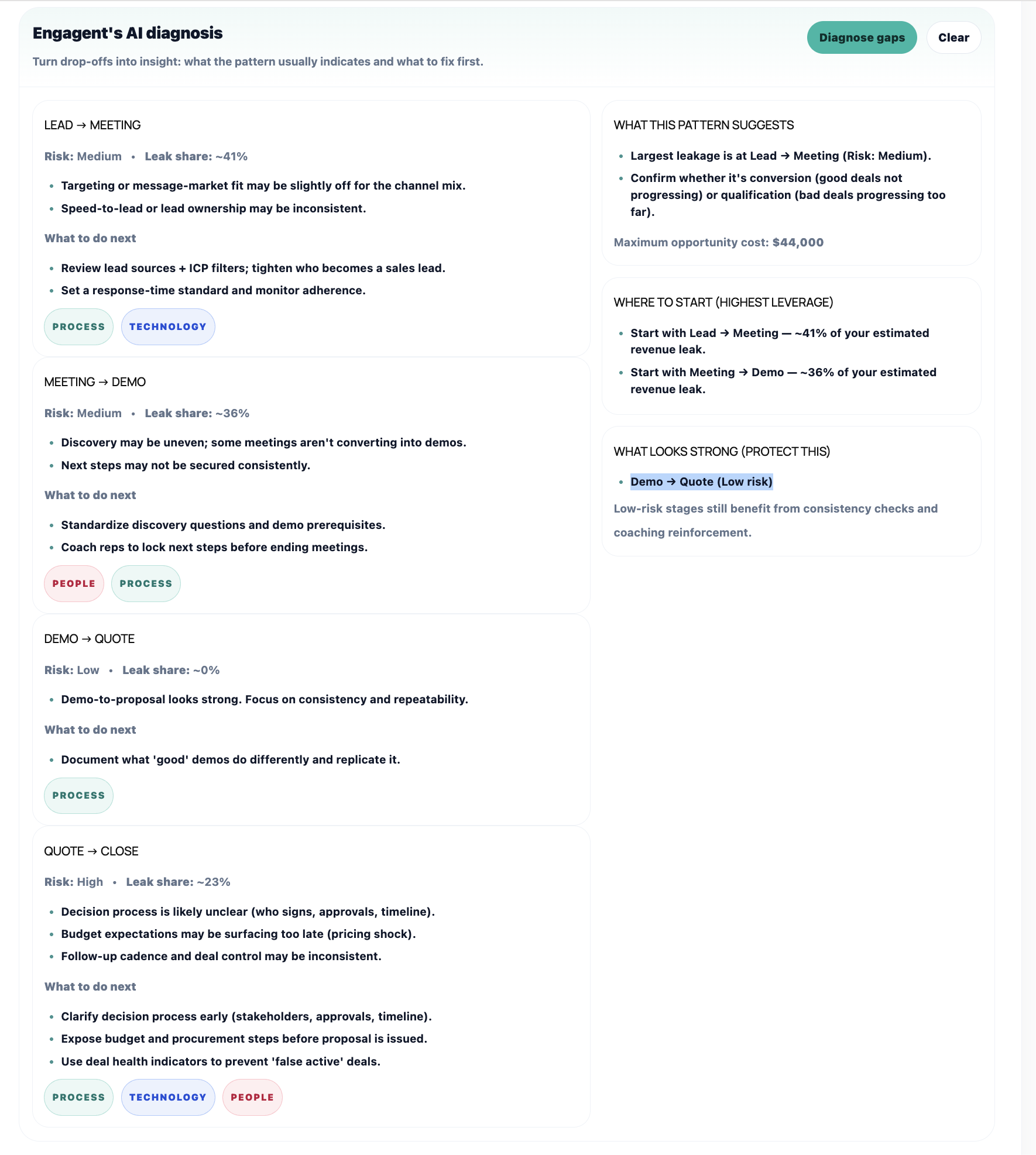
When I ran the AI diagnosis on this scenario, it flagged gaps at three distinct stages, each pointing to a different root cause:
→ How the Engagent People → Process → Technology framework works
Lead to Meeting — Medium Risk (41% of total leakage)
What the diagnosis flagged: Targeting or message-market fit may be slightly off for the channel mix. Speed-to-lead or lead ownership may be inconsistent.
People lens: Is the right person following up on incoming leads, and are they doing so quickly enough? Process lens: Is there a defined response-time standard? Is there a clear handoff from marketing lead to sales contact? Technology lens: Is the CRM capturing every lead and routing it correctly? Are leads going cold in an unassigned queue?
What to fix: Review lead sources and ICP filters. Tighten the criteria for what qualifies as a sales lead. Set a response-time standard and monitor it through your CRM reporting.
Meeting to Demo — Medium Risk (36% of total leakage)
What the diagnosis flagged: Discovery may be uneven. Next steps are not being secured consistently at the end of meetings.
People lens: Does the rep have the discovery skills to identify genuine need and create urgency for the next step? Process lens: Is there a standardised discovery framework — whether BANT, MEDDIC, Gap Selling, or your own methodology — being applied consistently? Technology lens: Is the CRM being used to log meeting outcomes, agreed next steps, and follow-up tasks? Or is that information living in the rep's notebook?
What to fix: Standardise discovery questions and demo prerequisites. Coach reps to secure a committed next step before ending every meeting — not as a courtesy, but as a non-negotiable part of the process.
Quote to Close — High Risk (23% of total leakage)
What the diagnosis flagged: The decision-making process is likely unclear. Budget expectations may be surfacing too late. Follow-up cadence after the quote may be inconsistent.
People lens: Is the rep engaging the actual decision-maker, or presenting to someone who cannot approve the purchase? Process lens: Is there a follow-up cadence defined for proposals? Are there deal health indicators that flag stalled quotes before they go cold? Technology lens: Is the pipeline stage in the CRM reflecting reality? Are there deals showing as active that have not moved in 30 days?
What to fix: Clarify the decision process early — who signs, who approves, what the timeline looks like. Surface budget and procurement steps before the proposal is issued. Use deal health indicators in HubSpot to prevent proposals sitting in the pipeline without forward motion.
How to Have the Right Coaching Conversation
Here is where most pipeline reviews go wrong.
The manager sees the gap. They put the numbers on the table. The rep gets defensive. The manager gets frustrated. Forty minutes later, nothing useful has been agreed and the rep leaves the meeting feeling managed rather than coached.
The better approach is to go into HubSpot together.
Pull up the meetings from last month. Walk through each one, who was the contact, what was the conversation, what was the agreed next step, and did that next step actually happen? You are not building a case against the rep. You are building a shared understanding of where the funnel broke, so you can fix it together.
This is the shift from performance management to revenue operations. The conversation moves from "why didn't you do enough?" to "what does the data tell us, and what do we change?"
And here is the part that often gets overlooked: none of this requires the rep to have written a report. If your CRM is being used correctly, the data is already there. Every meeting logged. Every deal created — or not created. Every follow-up task. The rep just had to do their job and record their activity. HubSpot surfaces the rest.
That is what a properly configured CRM gives a sales manager. Not just a contact database. A coaching infrastructure.
Four Causes Worth Investigating Before You Draw Conclusions
If you are seeing a similar gap in your own pipeline, here are the four areas to examine before forming a view:
1. Lead quality Were the people in those meetings actually in-market, decision-ready, and qualified? If not, no amount of activity improvement will fix the conversion. The problem is upstream — in how leads are being sourced, scored, and handed to sales.
2. Qualification discipline Is there a consistent qualification methodology being applied — or is the rep taking every available meeting to hit an activity target? There is a meaningful difference between a meeting and a qualified sales opportunity. Your qualification framework, whatever it is, needs to be applied before the calendar invite goes out.
3. Sales cycle timing A deal that did not close in May may not be a lost deal. It may be a deal that needs another 30 to 60 days. Pipeline figures capture what was created, not what will eventually close. Understanding your average sales cycle length is essential context for reading any monthly pipeline comparison.
4. Deal complexity The larger and more complex the deal, the more stakeholders are involved — decision-makers, budget holders, technical teams, compliance, legal. More complexity means longer cycles and more potential points of failure. That is not an excuse for low pipeline numbers. It is a variable that needs to be factored into how you interpret them.
Key Takeaways
- More meeting activity does not guarantee more pipeline. Volume and value are different metrics and need to be read together.
- When pipeline drops despite increased meetings, the gap is almost always at a specific funnel stage, not spread evenly across the process.
- The People → Process → Technology framework is the most reliable diagnostic tool for identifying the root cause of a funnel breakdown.
- A well-configured CRM gives sales managers the data to coach from evidence rather than impression, without requiring the rep to produce a separate report.
- The maximum opportunity cost in the example scenario was $44,000. Knowing that number is the starting point for the right conversation.
Frequently Asked Questions
-
What does it mean when a sales rep has more meetings but less pipeline? It means the funnel has a conversion problem at one or more stages. More meetings without addressing conversion drop-off accelerates revenue loss rather than revenue growth. The first step is mapping where prospects are leaving the funnel — Lead to Meeting, Meeting to Quote, or Quote to Close — and identifying the root cause at each stage before drawing conclusions about rep performance.
-
What is lead leakage and how does it affect sales revenue? Lead leakage is the revenue lost when prospects drop out of the sales funnel before converting. It occurs at every stage of the process. In the example in this article, 25 leads entering the funnel produced only 3 closed deals and $6,000 in revenue — against a maximum opportunity cost of $44,000. Leakage is rarely visible in activity reports, which is why funnel-stage conversion data is essential for accurate revenue diagnosis.
-
How do you diagnose a revenue gap in a sales funnel? Map your lead volume against conversion rates at each stage of the funnel — Lead to Meeting, Meeting to Demo or Quote, Quote to Close. Identify where the largest drop-off is occurring. Then apply the People → Process → Technology framework to each gap: Is the problem a skills or behaviour issue with the rep? A process that is not defined or not being followed? Or a technology gap — data not being captured, leads not being routed, pipeline stages not reflecting reality?
-
What should a sales manager look at in a monthly pipeline review? Beyond top-line activity figures, a sales manager should examine: stage-by-stage conversion rates compared to the previous period, the ratio of meetings held to quotes generated, the number of deals created versus meetings logged, the age of open deals in each pipeline stage, and the gap between pipeline created and pipeline expected based on lead volume. HubSpot's Sales Insights report provides most of this at the rep level without requiring additional reporting from the team.
-
How does HubSpot help sales managers identify pipeline gaps? HubSpot's Sales Insights report shows meeting activity, pipeline created, and period-over-period comparisons at the individual rep level. When a discrepancy appears between activity volume and pipeline value, managers can drill into individual meetings, review deal creation records, check logged next steps, and identify exactly where the conversion broke down. This makes the coaching conversation data-led rather than opinion-led — and removes the need for manual reporting from the rep.
Run the Numbers on Your Own Pipeline
The Engagent Lead Flow and Leakage Calculator is available free at engagent.io. Input your lead volume, average deal value, and conversion rates at each stage — and see exactly where your pipeline is leaking and what it is costing you in real terms.
→ Try the Lead Flow and Leakage Calculator — engagent.io
If you want to talk through what the numbers are telling you, or explore how to build this kind of visibility into your sales process using HubSpot, get in touch with the Engagent team.
→ Book a conversation with Engagent

COMMENTS