

Most businesses that come to us have HubSpot. Some of them have had it for two or three years.
They’ve got contacts, deals, pipelines, dashboards, the whole setup. And yet when we sit down and ask them one simple question, “What happens to a lead between first contact and closed deal?” the room goes quiet.
Not because they don’t care. Because nobody ever designed a system to answer that question.
That’s the gap between having a CRM and running one. And it’s the gap most HubSpot implementations never close.
HubSpot’s own sales certification framework maps the problem clearly:
Identify → Engage → Convert → Optimise
Four stages. Four sets of tools. One connected operating logic. But here’s what the certification can’t teach you: what that system actually looks like inside a real business, with real reps, real pipeline pressure, and a CRM that’s been through three different owners.
|
THE AECM INTERPRETATION At Engagent, we interpret this through our own operating lens — AECM: Attract, Engage, Commit, Measure. It’s not a replacement for HubSpot’s model. It’s the layer on top of it that explains how the system actually behaves under real-world conditions. HubSpot shows you what to build. AECM tells you why each stage either works or doesn’t. |
This piece walks through each layer of that system: what HubSpot is actually trying to teach, where most companies break down, and what it looks like when it’s working properly.
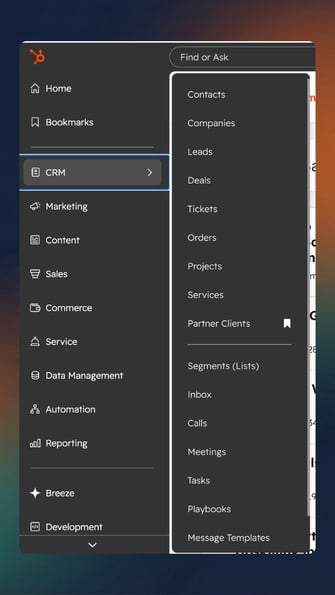
Stage 1: Identify (Attract)
You Don’t Have a Lead Problem. You Have a Definition Problem.
Ask most sales teams how they define a lead and you’ll get one of two answers. Either they’ll describe a type of person, “someone in our target market” — or they’ll gesture broadly at their CRM contact list. Neither answer is a definition. They’re both descriptions of a database.
HubSpot makes an important distinction that most implementations ignore entirely: contacts are not leads. A contact is a record. A lead is an actionable sales opportunity, someone who has been qualified, who fits your Ideal Customer Profile, and who is genuinely ready for a sales conversation. Creating a lead record before that qualification has happened isn’t efficiency. It’s noise.
The distinction matters because it determines everything downstream. If Sales is working a pipeline full of unqualified contacts dressed up as leads, they are burning capacity on conversations that were never going to close. That’s not a sales problem. That’s a qualification architecture problem, and it lives in how your lifecycle stages and lead stages have been configured.
|
ENGAGENT INSIGHT Most companies don’t use HubSpot as a qualification system, they use ist as a basic contact database. Every name that fills in a form becomes a ‘lead.’ Sales spends 60% of its time filtering rather than selling. The fix isn’t a better sales team. It’s a proper handoff architecture between Marketing and Sales, built into the CRM before any outreach begins. |
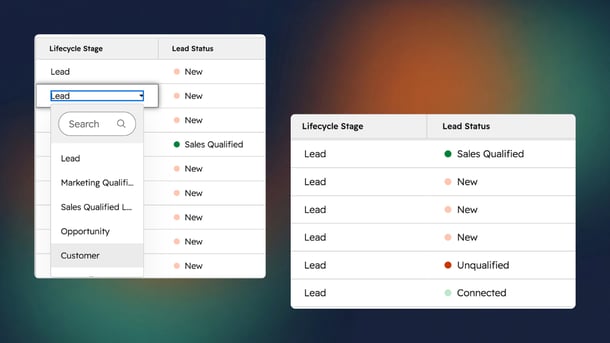
Lifecycle stage tells you where someone is in the journey, subscriber, lead, MQL, SQL, customer. Lead stage tells you where Sales is with them — new, working, open, unqualified. They are different things and they answer different questions. When both are configured correctly, you can look at your CRM at any point and know, objectively, whether a contact is ready for Sales, and Sales knows what to do the moment a record lands in their queue.
This is foundational. If you skip it, you don’t have a pipeline. You have a list.
Stage 2: Activity (Engage)
Activity Is Not a Strategy. Execution Is.
Here’s a number that should make most sales leaders uncomfortable: the average sales rep spends less than 40% of their time actually selling. The rest goes to admin, logging, scheduling, chasing, and trying to remember where they left off with a contact they last spoke to three weeks ago.
HubSpot’s engagement layer — tasks, calls, emails, sequences, playbooks — is built to solve this. But almost universally, the tools are underused, misconfigured, or treated as optional. Sequences are set up once and never reviewed. Tasks aren’t enforced. Call logging is inconsistent. The result is a CRM that tells you what happened in the past but gives you no visibility into what’s happening now — or what should happen next.
Tasks: The Discipline Layer Nobody Uses Properly
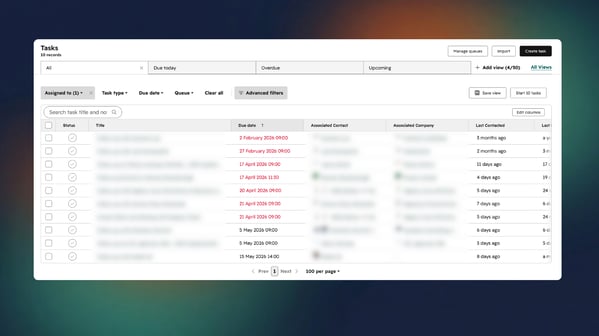
Tasks in HubSpot aren’t a to-do list. They are the mechanism by which a sales process becomes a repeatable system. When a contact moves from MQL to SQL, a task should fire automatically: call within 24 hours, send a specific email template, log the outcome. When that task is completed, the next one should be queued. When it isn’t completed, a manager should be able to see it.
If your reps are deciding what to work on each morning based on gut feel, you don’t have a process. You have individual sales styles, and you’re hoping they’re all good ones.
Sequences: Outreach That Respects Human Logic
Sequences automate the email and follow-up cadence so reps don’t have to manually chase every contact.
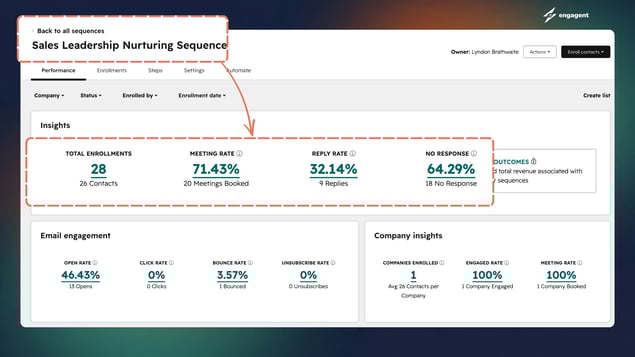
Done well, they stop the moment a contact replies or books a meeting, handing back to the human at exactly the right moment. Done poorly, they’re robotic and impersonal, damaging the very relationships they were supposed to nurture.
A sequence is not a mail shot. It’s a structured dialogue with one person, and every step has to feel like a natural next move in a real conversation.
|
ENGAGENT INSIGHT When we audit a client’s HubSpot engagement layer, the most common finding isn’t that sequences don’t exist — it’s that they exist and nobody knows what they contain. A sequence built 18 months ago, never reviewed, is being sent to new prospects today. That’s not automation. That’s organised neglect. |
Playbooks and Snippets: Standardising Quality at Scale
Playbooks give reps a guided framework for sales conversations qualification questions, objection handling, discovery prompts surfaced directly inside the contact or deal record. Snippets are reusable text blocks for common email passages.
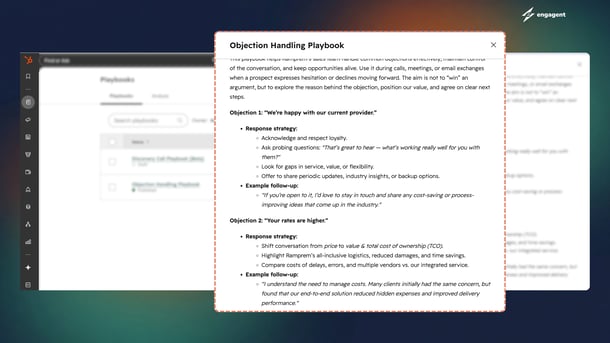
Together, they answer a question every sales leader should be asking: how do we ensure that every rep performs at the level of our best rep? Without them, sales quality depends entirely on individual talent. With them, the knowledge lives in the system, not in someone’s head.
Stage 3: Convert (Commit)
Most Pipelines Are Built. Almost None Are Designed.
The word ‘conversion’ is deceptive. It implies movement, a contact sliding from one stage to the next like water through a pipe. But what actually happens at this stage isn’t movement. It’s a decision. The prospect decides to proceed. The business decides this opportunity is real. Both sides commit to taking the next step. We call this stage Commit rather than Convert, because the language matters: you’re not tracking deal progression. You’re managing the conditions that make commitment possible.
There is an important difference between building a pipeline and designing one. Building a pipeline means creating stages and putting deals in them. Designing a pipeline means defining what has to be true, specifically, objectively, for a deal to move from one stage to the next. It means knowing what entry looks like, what exit looks like, and what a stuck deal is supposed to trigger.
Most HubSpot pipelines are built. Very few are designed. The consequence is a pipeline that’s visually satisfying and operationally useless, a list of opportunities organised by optimism rather than evidence.
The Deal Creation Problem
HubSpot is clear on this: deals should only be created when there’s a qualified opportunity.
-
Not when a contact downloads a resource.
-
Not when someone books a discovery call.
-
Not when a rep has a good feeling about a conversation.
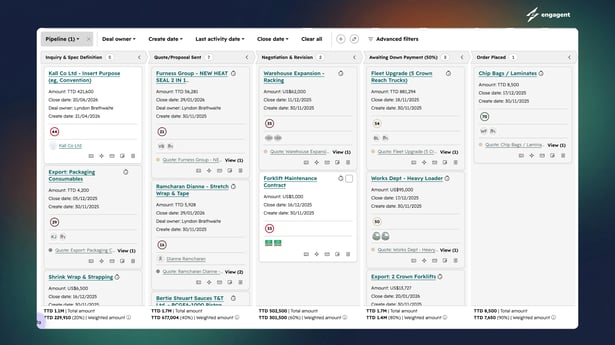
A deal represents revenue potential that Sales is actively working. Creating deals too early inflates your pipeline and destroys your forecast accuracy in one move.
The question to ask is: "What has to be true before a deal is created?"
If you can’t answer that with a specific, verifiable criterion, your pipeline entry point is undefined.
Meetings: The Scheduling Tax Nobody Talks About
Every back-and-forth email exchange spent agreeing on a meeting time is friction. Not dramatic friction, just the ordinary, invisible kind that slows everything down and subtly signals to prospects that working with you might involve a lot of administration. HubSpot’s meeting scheduling link eliminates this entirely. One link, the prospect picks a slot, it’s booked. That’s a pipeline velocity improvement that costs nothing to implement and almost nobody has set up properly.
AI and Deal Prioritisation
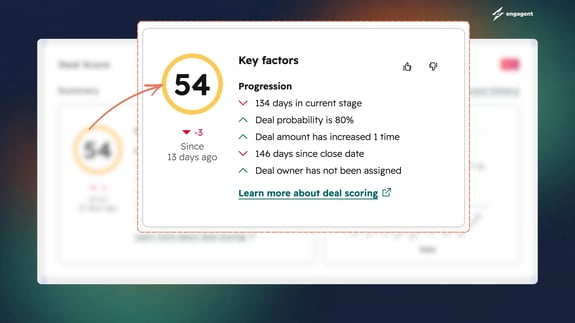
HubSpot’s Breeze AI layer adds a deal likelihood score to active opportunities, a prediction, based on activity signals and historical data, of which deals are most likely to close. This is useful, but only if the underlying data is clean.
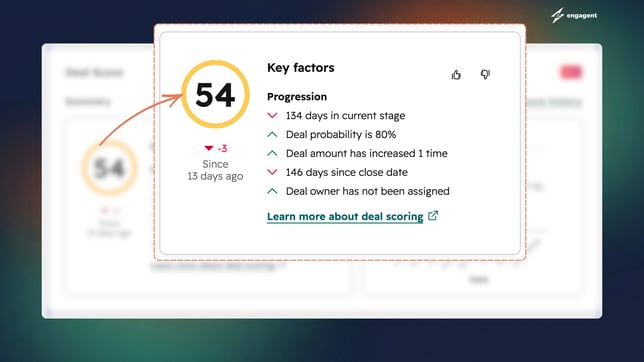
A deal with no logged activities, no recent notes, no email engagement — the model has nothing to work with. Garbage in, garbage out applies here just as much as anywhere else.
|
ENGAGENT INSIGHT The most common pipeline failure we see: beautifully structured stages with no exit criteria. A deal can sit in ‘Proposal Sent’ for 90 days with no consequence and no flag. Nobody’s chasing it because the system doesn’t know it’s stalled. Define what ‘stalled’ means — and build the workflow that surfaces it. |
Stage 4: Optimise (Measure)
Reports Don’t Create Insight. Structure Does.
HubSpot has excellent reporting infrastructure. Dashboards, prebuilt templates, custom reports, goal tracking, forecast views — it’s all there. None of it will tell you anything useful if the data flowing into it is inconsistent, incomplete, or structurally wrong.
This is the section most HubSpot conversations skip entirely. Implementation gets done, the pipeline is built, sequences are running — and then someone pulls a report and the numbers don’t make sense. Deals in the wrong stages. Forecast that doesn’t match reality. Conversion rates that can’t be right. The impulse is to blame the reporting. The problem is always upstream.
Forecasting Is Only As Good As Your Pipeline Hygiene
HubSpot’s forecasting tool works by taking the weighted probability of deals at each stage and projecting expected revenue. The accuracy of that projection depends entirely on two things: whether your stage probabilities are realistic, and whether your deals are actually in the right stages. If reps are moving deals forward to look productive, or leaving them where they are because they haven’t updated them, your forecast is fiction dressed up as analysis.
This is why pipeline review isn’t just a management preference — it’s the maintenance that keeps your forecasting system honest.
Conversation Intelligence: Turning Calls Into Coaching
One of the most underused features in HubSpot Sales Hub is Conversation Intelligence the call recording and transcription layer that tracks talk ratio, keyword mentions, and call outcomes. Most teams treat it as a logging tool. It’s actually a coaching infrastructure.
When a manager can pull up any call, see what percentage of the conversation the rep dominated, flag specific moments for review, and build training playlists from real examples — coaching stops being based on memory and starts being based on evidence. That shift from intuition-led to data-led coaching is where sales teams actually improve systematically rather than just hoping the next hire is better than the last.
|
ENGAGENT INSIGHT We’ve seen organisations invest significantly in sales training — workshops, courses, external coaches — while their own call library sits untouched inside HubSpot. The best training material you have is the calls your best reps are already making. The system records them. The question is whether anyone is using them. |
The System That Connects It All
Identify, Engage, Convert, Optimise. Four stages, four sets of tools, one connected architecture. The mistake most implementations make is treating these as separate projects rather than a single operating logic. You can configure your lifecycle stages perfectly and still have a broken pipeline if the deal creation criteria aren’t defined. You can build brilliant sequences and still miss forecast if the conversation intelligence data isn’t feeding your coaching conversations.
At Engagent, we organise this logic around AECM — Attract, Engage, Commit, Measure. It maps directly to HubSpot’s framework, but it names each stage by what it’s actually trying to produce, not just what it’s called in the software.
|
Attract |
Engage |
Commit |
Measure |
|
↓ → |
↓ → |
↓ → |
↓ |
|
Quality |
Execution |
Decision |
Insight |
Attract is about quality, who enters your system, and whether they should. Engage is about execution, whether your team is doing the right things consistently with the right people. Commit is about decision, whether the conditions exist for a prospect to move forward and a rep to confidently ask them to. Measure is about insight, whether the data you’re generating tells you something actionable, or just fills a dashboard.
The system works when each stage feeds the next. Qualified contacts flow into structured engagement. Structured engagement creates the conditions for commitment. Commitment generates deal data. Deal data, properly captured, drives the coaching and forecasting that improve the whole cycle. Break any one of those connections and you’ll feel it in your numbers — but you may not immediately know where it broke. That’s the diagnostic work. And that’s where most HubSpot partners don’t go.
Where to Start
If you’re reading this and recognising your own pipeline in any of the failure patterns above, the starting point isn’t a new tool or a new integration. It’s a diagnostic question: which stage of your system is broken?
- If unqualified contacts are flooding your pipeline — that’s an Attract issue. The quality filter before Sales doesn’t exist.
- If reps are going off-script, sequences are performing inconsistently, or follow-up is falling through the cracks — that’s an Engage issue. Execution is relying on individual discipline rather than system discipline.
- If deals are piling up in stages without movement — that’s a Commit issue. The criteria for progression are undefined, so nobody’s driving a decision.
- If your reports produce numbers nobody believes or acts on — that’s a Measure issue. The data isn’t structured well enough upstream to mean anything downstream.
Start with the honest answer to that question. Then build from there.
Poor systems create friction — the invisible drag that slows deals, frustrates reps, and erodes revenue. Good systems create force: the momentum that compounds over time as each stage strengthens the next. The difference between those two outcomes isn’t the tool. It’s the design behind it.
|
ENGAGENT POSITIONING We don’t implement HubSpot. We design the system that makes HubSpot work.That distinction isn’t semantic. It determines what you get at the end of an engagement, a configured platform, or a revenue engine. Most implementations stop at the platform. We start there and build toward the engine.If you want a second opinion on where your system breaks down, that’s the conversation we’re built for. |

COMMENTS