
At the end of Q1, I opened HubSpot and looked at one number.
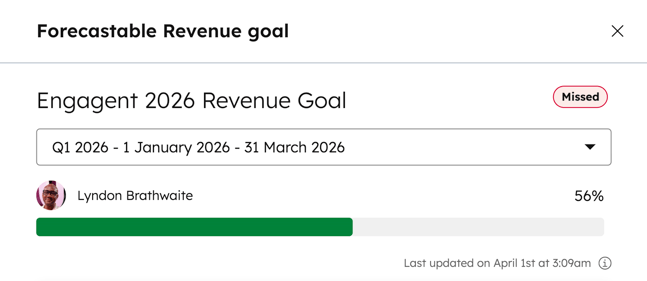
56%.
That was our progress against the Engagent 2026 Revenue Goal, pulled directly from the Forecast tool. Not 100%. Not close. The label next to it said it plainly: Missed.
If you have ever missed a quarterly revenue target, the answers to what went wrong are usually already sitting in your pipeline. This is how we read ours.
I am sharing this because this is exactly the kind of moment most people in this industry do not talk about. Everyone posts about hitting targets. Nobody shows you the screen when they did not.
But if you are building a business, or managing revenue for one, the moments that matter most are not the wins. They are the ones where you have to sit down, look at what the numbers are telling you, and make a decision about what to do next.
That is what this post is about.
Before I Looked at the Dashboard, I Went Back to the Plan
The instinct when you miss a target is to react. To start moving things. To add more activity.
But the first thing I actually did was go back to the start of the year.
What did we say we were going to do? What was the go-to-market strategy? What types of deals were we targeting? What did we expect in terms of deal size, deal volume, and the kinds of clients we were going after?
Because if you skip that step, you are not reviewing performance. You are reacting to a number without any context for what it means.
Then I Opened the Pipeline
HubSpot's Deals index page gives you a full view of everything in motion: deal name, stage, deal type, close date, and amount, all in one place. I filtered to our 2026 deals and looked at what was actually there.
14 deals in total. Some closed. Most still open.
The summary metrics at the top of the view told the immediate story:
- Total deal value in pipeline: well over TTD 400K
- Closed deal amount: just under TTD 62K
- Open deal amount: over TTD 356K
- Average deal age: 43.8 days
On the surface, you could look at that and say: there is a lot in the pipeline. And there is. But that is not where the review ends.
What the Numbers Were Actually Telling Me
Here is the first thing that became clear: demand was not the problem.
We had conversations. We had opportunities created. We had engagement from prospects.
So the easy answer, "we need more leads," would have been wrong. And comfortable. And it would have sent us in exactly the wrong direction.
The real questions were harder:
- Why is so much of the pipeline still open?
- Are deals progressing with intent, or are they just sitting in stage?
- Are next steps clearly defined and committed to?
- What is the average deal actually worth, and does that deal size support the business we are trying to build?
These are not questions you can answer from a spreadsheet. They require you to look at individual deal records, check the last activity date, review what was logged in the notes, and understand the pattern across the whole pipeline. Not just the total number.
The Sales Cycle Issue Nobody Talks About Honestly
When I looked at that average deal age, 43.8 days, something clicked into place.
We operate on a 30 to 45 day sales cycle. That figure was sitting right there in the Deals index summary, and it confirmed what I already suspected.
Which means:
- Deals created in mid-January were never going to close in January
- Deals created in late February were feeding March or April
- A significant portion of what we built in Q1 is actually Q2 revenue
So when you look at Q1, you are not just looking at Q1. You are looking at the decisions made in Q4. The pipeline built in January. The discipline of follow-up in February.
That lag is real. And if you do not account for it, you will misread your own performance every single time. The Forecast tool in HubSpot makes this visible. You can track your quarterly target progress month by month and see exactly where the trajectory was building and where it fell short.
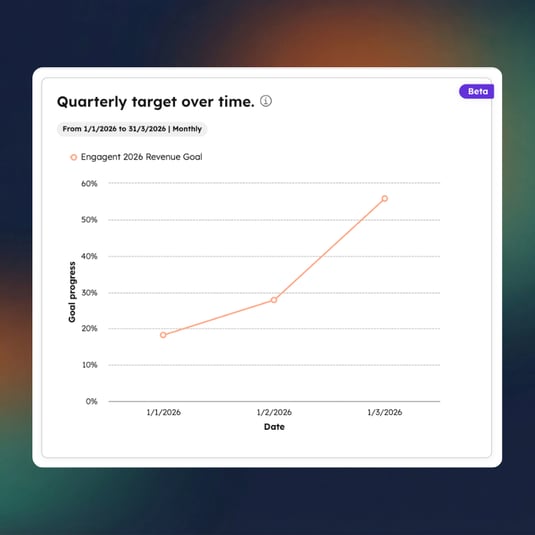
That chart told me we were growing, just not fast enough to close the gap in time.
Deal Size Was the Other Conversation I Had to Have With Myself
You can be busy and still be under pressure.
That is one of the most uncomfortable truths in running a small business. Activity does not equal sustainability.
When I looked at the deal breakdown, new business versus existing business, local versus regional, larger implementations versus smaller service contracts, the picture became clearer. Not every deal in the pipeline was sized in a way that moves the business forward at the pace we need.
Revenue is not about activity. It is about alignment: between what you are selling, who you are selling to, and what the business actually needs to sustain itself and grow.
What Else Became Clear: The ICP Is Broader Than We Thought
One of the more useful things to come out of the Q1 review was this: we started seeing opportunities from industries we had not originally defined as our core target.
Engagent came up in the context of automotive and higher education because that is where a lot of our early experience was built. But what kept appearing in the pipeline was that the problem, fragmented sales processes, poor pipeline visibility, revenue leakage between teams, is not industry-specific.
If you have a sales team, if you are trying to manage a revenue number, if you have gaps between your marketing and sales and service functions, you have the same problem regardless of what sector you are in.
Q1 gave us a validation: the ICP needs to broaden. Not because we are abandoning focus, but because the data told us the problem is more universal than we had been positioning for.
The Geography Question
Something else stood out when I looked at the pipeline breakdown by deal type and origin.
The majority of our deals are local or regional. We had a couple of regional opportunities and very little early-stage international conversations, but nothing confirmed internationally just yet.
That matters because part of what we are building towards in 2026 is a business that is not solely dependent on the local market. So one of the Q2 priorities is being more deliberate about how we develop and track international pipeline. Not just waiting for it to appear, but actively creating the conditions for it.
So What Did We Do Going Into Q2?
We did not reset. Pipeline does not respect quarters.
What we adjusted was our approach:
- Being more deliberate about deal progression: every open deal needs a clear next step with a date attached, logged in HubSpot so nothing falls through the gap
- Being more intentional about deal size and whether new opportunities genuinely fit the profile of what we are building
- Starting Q2 with an active effort to seed international pipeline, not just wait for inbound
- Continuing to look at what we can generate from existing clients: upsell, cross-sell, and ongoing retainer relationships
That last point is important. New business is necessary. But existing relationships are often the most efficient path to consistent revenue. Both have to be managed with the same rigour, and both have to be tracked in the same place.
A Note on How This Information Gets Surfaced
I want to be direct about something, because it is relevant to everything above.
None of this analysis came from a spreadsheet. None of it came from an ERP report.
It came from HubSpot, specifically from three places:
- The Deals index page, which gives a real-time view of every opportunity, its stage, its value, its age, and its deal type in a single filterable view
- The Forecast tool, which tracks progress against a revenue goal over time and shows you exactly where you are relative to your target at any point in the quarter
- Individual deal records, which hold the activity history, notes, and next steps that tell you why a deal is where it is, not just that it is there
This is the distinction that matters: an ERP is built for transactions. A CRM is built for relationships and pipeline. They are solving different problems. If you are using your ERP to manage your sales pipeline, or you are still tracking deals in Excel, you are working with a tool that was not designed for this job.
Excel can hold data. It cannot tell you that your average deal age has drifted to 43 days. It cannot show you a forecast trend line against a quarterly target. It cannot flag that a deal has had no activity in three weeks and is likely stalling.
A properly configured CRM does all of that. And when it does, the quarterly review stops being a scramble and becomes a structured conversation with your own business.
That is revenue operations done properly. Not the theory of it. The actual practice.
The Part That Ties All of This Together
Here is what I want you to take from this if you are a sales leader, a founder, or anyone responsible for a revenue number:
The activities of Q1 feed the results of Q2 and Q3. The activities of Q2 feed Q3 and Q4. This is not a metaphor. It is how pipeline actually works.
Which means the question is never just "what happened last quarter." It is: what did we do, when did we do it, and are we doing the right things now to make the next quarter look different?
The answers are already in your pipeline. In your deal stages. In your average deal age. In the gap between what closed and what is still sitting open.
You just have to be willing to read them honestly, and have the right system in place to surface them clearly.
Why I Am Sharing This
Because this is the same work we do with clients.
When we sit down with a business to look at their revenue performance, we are not bringing a complicated model or a theoretical framework. We are asking them to look at what their own data is telling them — and helping them understand what to do about it.
The only difference here is that the business is ours.
We did not hit our Q1 target. We know why. We know what we are adjusting. And we are being transparent about it — because the businesses we work with are going through the same thing, and pretending otherwise does not help anyone.
If you are looking at your own pipeline right now and asking some version of these questions, that is where the work starts. Not in a dashboard. Not in a strategy session. In an honest conversation with what your numbers are actually telling you.
--------------------------------------------------------
Engagent is a strategy-first CRM consultancy and HubSpot partner. We help businesses in the Caribbean and beyond close the gap between their revenue goals and their revenue results. If this resonated, the conversation starts at https://www.engagent.io