

I wasn't in Boston for UNBOUND, and I want to say that upfront. I followed it as a HubSpot partner from my cozy office in Trinidad and Tobago: the keynote coverage, HubSpot's own announcements, and what practitioners were posting afterwards.
Watching from a distance has one advantage: you see what people keep repeating once the conference energy wears off. One idea kept coming back.
What HubSpot announced
UNBOUND is the new name for what used to be INBOUND, and the rebrand tells you where HubSpot's head is. The announcements fell into three themes:
- A CRM that updates itself. A self-updating Smart CRM captures calls, emails and meetings and proposes record updates for the rep to approve, alongside a Context Home that shows how complete your business context is.
- More capable AI. A rebuilt Breeze Assistant that carries out tasks instead of only answering questions, and an Agent Builder for creating custom agents by describing what you want.
- More of the go-to-market stack. Marketing Studio, sales tools that turn meeting transcripts into CRM updates, and quote generation in Revenue Hub.
That's a lot of product. But the product wasn't the headline.
The number that stuck with me
Yamini Rangan opened with a slide that said it all: 90% of companies use AI, and only 6% are seeing transformation.
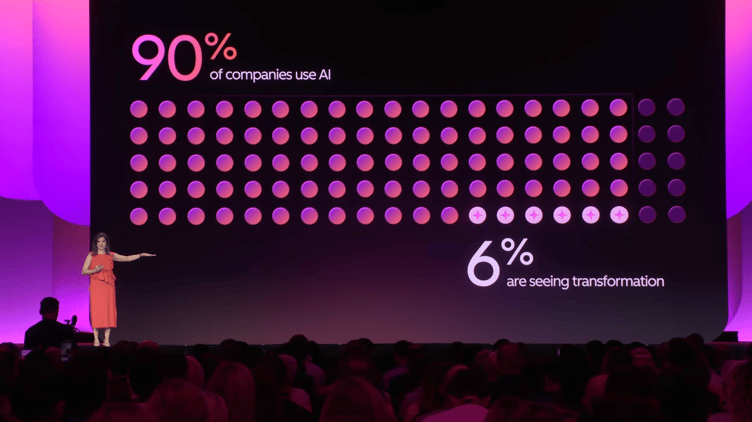
The figure comes from HubSpot's own State of AI research, which surveyed more than 6,000 professionals globally across marketing, sales, service and leadership. Ninety percent said their company uses AI. Only 6% rated their company a transformative adopter. That is HubSpot's research, and the 6% is people rating their own company, so I'd treat it as a strong signal, not an audited scoreboard.
HubSpot's answer is what it's calling the Outcomes Era: stop collecting AI tools, and start from the result you want. It also published figures from its own customer base. Where AI had good business context behind it, MQLs were up 264%, closed-won deals up 197% and meetings booked up 200%. Where the context was bad, the same measures went down: MQLs down 28%, closed-won down 27% and meetings booked down 49%. HubSpot's own summary was that AI with bad context was worse than no AI at all.
Take those uplift numbers with the right amount of salt. They are HubSpot's data, from HubSpot's customers, with no methodology published that I could find. I'd treat them as a direction, not a forecast. But the direction matches what I see in client work every week.
The outcomes have not changed. The operating system has.
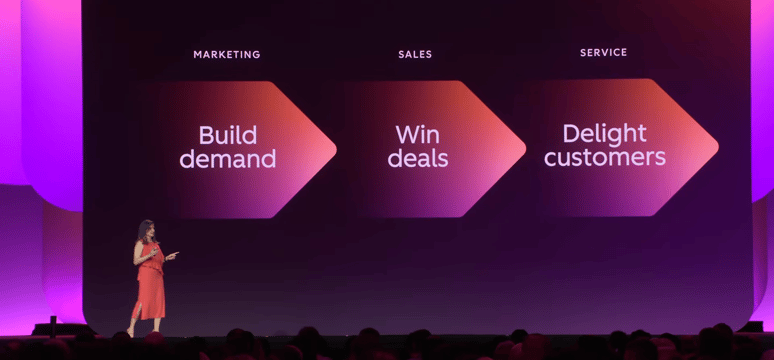
One of Yamini's simplest points may also be the most important. For all the change in technology, the outcomes of go-to-market have not changed. Marketing still has to build demand. Sales still has to win deals. Service still has to delight customers and earn retention.
That is the flywheel in different language. The destination is familiar; what is changing is the way the work gets done.
We have seen this pattern with every major business platform. Nearly every company has email. Most established businesses have an ERP or accounting system. More companies now have a CRM, and almost everybody is experimenting with AI. But owning these tools is not the same as making them work together strategically.
A CRM sitting beside your inbox, ERP and AI tools is still largely a database. The value begins to change when the CRM can understand the conversations in email, the transactions in the ERP, the activity across the customer journey, and the rules by which the business actually operates. That is when technology starts working as a connected system around an outcome instead of as a collection of subscriptions.
Fewer use cases. Better connected.
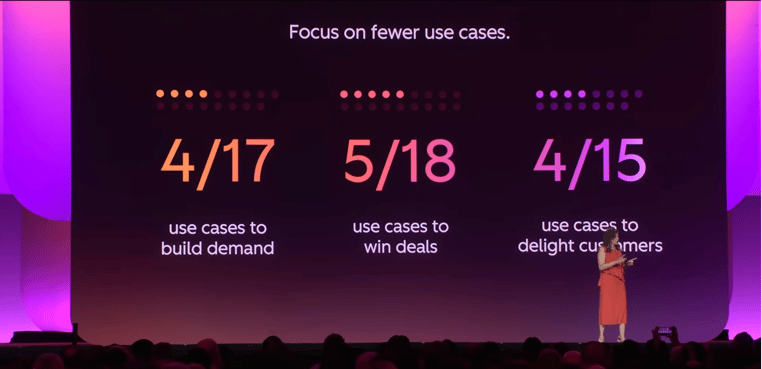
The other part of Yamini's argument cuts against the pressure many teams are feeling. The companies reporting the strongest results are not trying every possible AI use case. In HubSpot's research, they concentrated on roughly four or five use cases in each part of the customer journey—and executed those use cases well.
That matters because activity is easy to mistake for progress. Generating another email or another piece of content is fast, but it may not create an advantage. The higher-impact applications in the keynote—analyzing campaign performance, prioritizing pipeline and acting on customer feedback—depend on information that is specific to the business.
This is much closer to what I see with clients. The question is rarely, “What else can we switch on?” The better question is, “Which one or two workflows would materially improve demand, conversion or retention, and do we have the data, definitions and ownership to make them work?”
My take: we've done this before
I keep thinking about how businesses bought CRM. Plenty of them bought it because everyone else had one, or, they felt they needed one, loaded it with contacts, and then wondered why nothing changed. The tool wasn't the problem. Nobody had decided what the tool was for.
AI is following the same script, only faster. It started as a real buzz, and a lot of organisations went straight to having it. But having it and using it are different things. In many companies, a few people use AI regularly, most don't, and nobody has connected it to a specific outcome. It becomes one more layer on top of the CRM, the email platform and everything else, with no one responsible for what it's supposed to achieve. That's how you end up with a stack of tools instead of a strategy, and it fits the 90% and 6% picture.
This is why I keep saying CRM is not software. It's a business strategy supported by people, process and technology, and AI belongs in the technology part. If the people don't trust it, the process doesn't tell it what to do, and the data underneath is messy, it can't fix any of that. It amplifies it. Tom Wright, a fellow HubSpot partner who was at UNBOUND, made the same point in his recap on LinkedIn: AI on top of messy data doesn't fix the mess, it amplifies it.
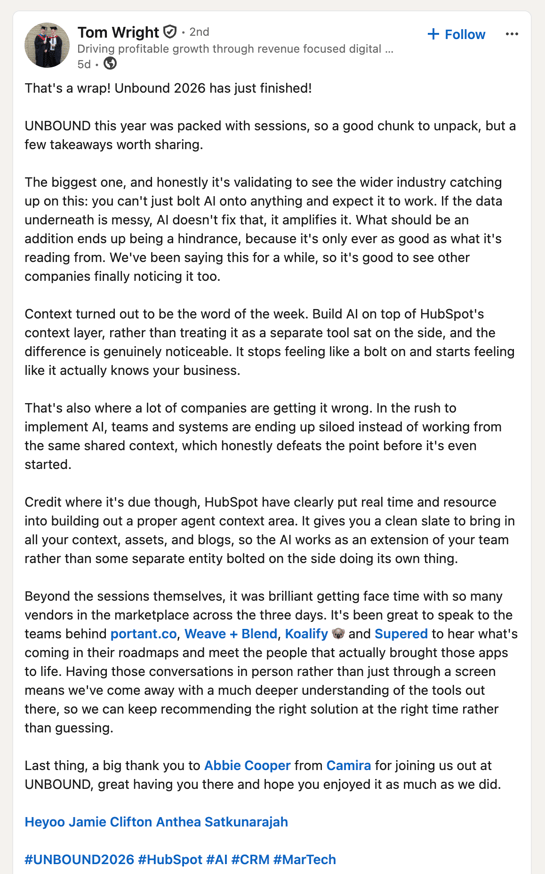 Tom Wright's UNBOUND 2026 recap on LinkedIn.
Context is more than customer data
When people hear “context,” they often think it means putting more fields into the CRM. Yamini's definition was broader and more useful.
Business context is what the company does, how it is positioned, what it sells, and how it should sound. Customer context is the history of conversations, personas, needs, intent and buying signals. Team context is who owns what, which goals matter, how work moves, what requires approval, and which methodology the team follows.
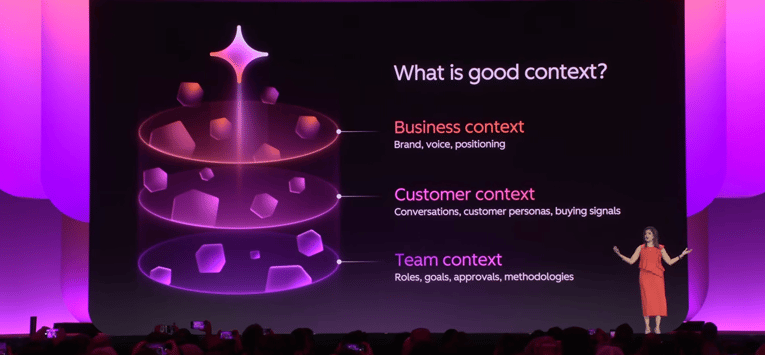
HubSpot defines good context across three layers: the business, the customer and the team. Source: Yamini Rangan's UNBOUND 2026 keynote.
In many businesses in the Caribbean, those three layers live in different places.
- The positioning is in a presentation.
- Customer conversations are in inboxes and meeting recordings.
- Transactions are in the ERP. Process knowledge sits in a manager's head.
The CRM contains some of the record, but not always the meaning behind it.
Connecting those systems is not integration for integration's sake. It is how the business gives AI enough understanding to act usefully. If the AI knows the customer but not the approval path, it can create work the team cannot safely use.
If it knows the product catalogue but not the current positioning, it can be accurate and still be wrong for the business. If the underlying definitions are inconsistent, automation simply moves the inconsistency faster.
That is why context has to be designed, maintained and owned. It is not a one-time data-cleaning exercise, and it is not something a model can infer reliably from a pile of disconnected records.
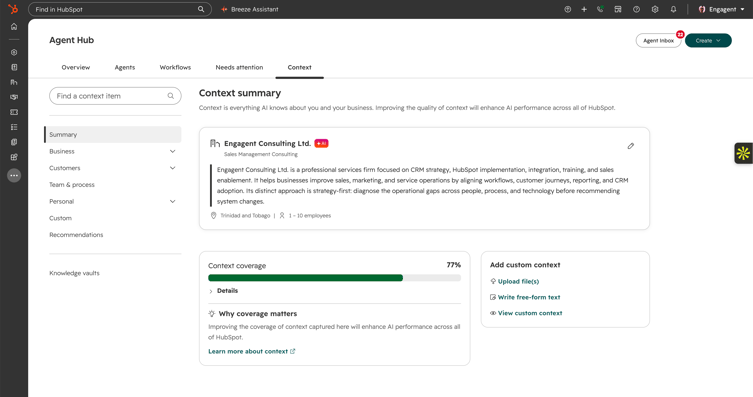 The context framework inside HubSpot's Agent Hub. Engagent's portal brings business, customer, team and process, personal, and custom context into one place, and shows how complete that context is before AI acts. Screenshot: Engagent HubSpot portal.
What I take from UNBOUND is that the fundamentals are back at the center. Before you switch on anything new, go back to why you invested in the tool in the first place. What outcome were you buying it for? More qualified leads? Faster follow-up? Better retention? Every investment comes back to return, and AI is no different. It isn't there to make us excited about technology. If it isn't tied to a goal, it's a dud.
I also want to say that HubSpot is moving up-market. It's building for more sophisticated teams. But what I keep hearing in its messaging is a recognition that the human is still part of the picture: people supply the judgment, the direction and the business meaning that the model doesn't have. That matters to the businesses I work with, most of which are small and mid-sized and don't have a data team to lean on.
What I'll be watching
I don't think this is a story without questions, and I'd rather name them than pretend. The self-updating CRM is only as good as the process behind it. Automatic capture will keep your records current, but if your team has three different definitions of a qualified lead, it will record all three faster than before.
A quick readiness check
Before you turn on any AI feature this quarter, be able to answer three questions:
- What is the one outcome this should move, and how will we measure it?
- Who owns the data and definitions the AI will rely on, and when did someone last check them?
- Where does a person review the work before it reaches a customer?
If you can't answer those, the feature isn't your next step. Your next step is the groundwork.
Where this leaves us
This is Part 1. Salesforce held Dreamforce the same week, with a very different tone, and in Part 2 I'll put the two side by side, because the contrast says a lot about who each company is building for.
Until then, I'm curious: how many AI tools does your team have switched on, and how many of them are tied to a number you can name?

Share your comments