

Most sales teams don’t miss targets because they aren’t working hard.
They miss targets because they’re working without math, without a clear, measurable model for how activity turns into revenue.
Calls go up. Emails go out. Pipelines look busy. But revenue still misses — or worse, revenue hits while profit quietly disappears. That’s why understanding your sales numbers is no longer a “sales skill.” It’s a strategy, operations, and budget discipline.
This post breaks down the simple math behind sales performance and shows how to turn targets into clear, measurable activity, without guessing.
The Shift: Moving from “Doing More” to “Knowing More”
Many teams plan based on effort:
“We’ll make more calls.”
“We’ll boost more posts.”
“We’ll push harder at the end of the quarter.”
High-performing teams plan based on numbers:
“We need X qualified opportunities per month to hit Y units or revenue.”
“And we know exactly where those numbers come from.”
That shift, from activity to math, is the difference between being busy and being effective.
The Core Sales Math (Simplified)
.png?width=610&height=343&name=Untitled%20design%20(1).png)
Every sales goal can be reverse-engineered using the same logic.
Whether you’re revenue-focused or unit-focused, the model works the same way.
You start with your goal and work backwards.
The Five Inputs That Matter
-
Your Goal
This can be:-
Revenue (e.g. $5M for the year), or
-
Units (e.g. 75 cars, 40 homes, 120 policies)
-
-
Average Deal Size (if revenue-based)
This determines how many deals you actually need. -
Closing Ratio (Qualified → Closed)
Example:-
10:1 means you need 10 qualified opportunities to close 1 deal.
-
-
Lead Conversion Rate (Unqualified → Qualified)
A common planning baseline is 15%.
This means only 15 out of every 100 leads are truly worth pursuing. -
Sales Cycle
How long does it realistically take to close once a deal starts?
None of this is theoretical.
This is the math already happening in your funnel, whether you track it or not.
Why Low Conversion Rates Turn Into a Budget Problem
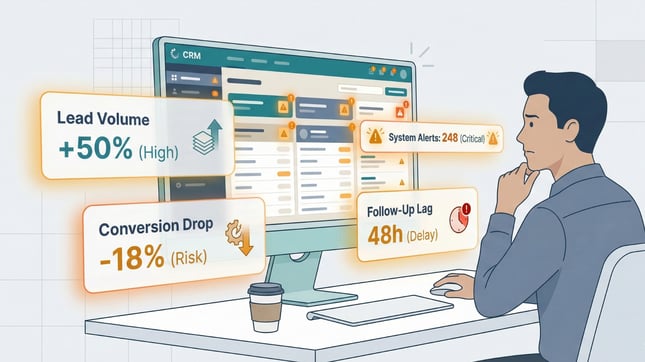
Let’s look at a simple monthly example. You want to close 6 deals this month.
Scenario A: Efficient Funnel (15% Conversion)
-
Deals needed: 6
-
Qualified opportunities needed (10:1): 60
-
Raw leads required at 15% conversion: 400
Scenario B: Inefficient Funnel (6% Conversion)
-
Deals needed: 6
-
Qualified opportunities needed: 60
-
Raw leads required at 6% conversion: 1,000
Same sales goal. Very different cost.
Those extra 600 leads aren’t free. They show up as:
-
Higher ad spend
-
More time wasted by reps
-
Slower follow-up
-
Higher customer acquisition cost
This is how companies hit revenue targets but miss profit targets.
Why This Isn’t a “Lazy Rep” Issue
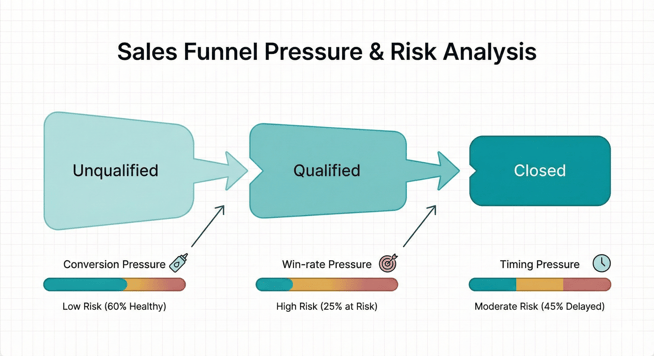
When conversion is low, the default reaction is often: “Sales needs to work harder.” But the math tells a different story.
In the inefficient scenario, reps are asked to process 2.5× the volume to achieve the same result.
That creates:
-
Lead overload
-
Slow response times
-
Deals dying in the pipeline
-
Burnout masked as “lack of urgency”
This isn’t an effort issue; it’s a system issue.
Stop Guessing: Turn Targets into a Repeatable, Measurable System
Instead of guessing, reverse-engineer.
Start with:
-
Your annual or monthly goal
-
Your real closing ratio
-
Your actual conversion rate
When you do that, two things become clear very quickly:
-
Whether the goal is realistic
-
Where the funnel is actually breaking
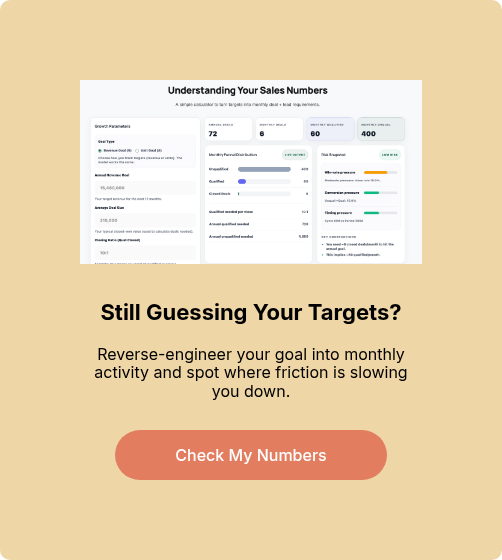
If the calculator says you need 4,800 leads a year and you can only afford or handle 2,000, you don’t have a motivation problem; you have a conversion or targeting problem.
Where Training Fits, and Where It Doesn’t
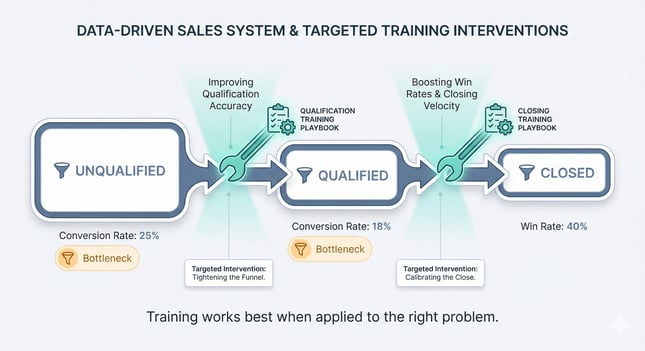
Sales Training is often the first solution suggested. But training only works when it’s aimed at the right constraint.
The numbers usually tell you which one it is:
-
Low Unqualified → Qualified conversion
This is not a closing issue.
It’s a targeting or qualification problem. -
Plenty of qualified opportunities, low win rate
This is a closing or negotiation skill gap. -
Deals stuck longer than the sales cycle
This isn’t training at all.
It’s a process, forecasting, or pipeline discipline issue.
Training without diagnosis doesn’t improve performance; it just adds cost. The numbers protect you from training the wrong thing.
How This Becomes Actionable in Your CRM
The calculator shows you what should be happening.
Your CRM shows you what is happening.
To keep the two aligned, focus on a small set of metrics:
-
Unqualified → Qualified conversion
-
Qualified → Closed-won conversion
-
Average days to close
-
Deals ageing beyond the sales cycle
If “qualified” isn’t clearly defined, none of the math holds. If conversion isn’t tracked, activity becomes noise.
This is how numbers become an operating discipline, not spreadsheets that get ignored.
Your Next Step:
Run the calculator, look at your numbers honestly, and ask one question:
Is the problem effort, or is it friction in the system?
Those answers will change everything.