


In many automotive dealerships, the first sales conversation often begins with financial questions. Sales representatives typically need to determine whether a customer can realistically afford a particular vehicle before discussing financing options or moving forward in the sales process.
This usually involves asking questions about:
- Monthly salary
- Existing loans
- Current financial obligations
- Potential down payments
While these questions are necessary, they can slow down the sales process and sometimes create unnecessary friction for both the customer and the sales representative.
However, modern CRM systems can improve this process significantly.
By using HubSpot forms, calculated properties, and CRM cards, dealerships can gather financial information in advance and generate a financial qualification snapshot directly inside the CRM. This allows sales representatives to begin the conversation with a clearer understanding of the customer’s financial position.
The Challenge in Automotive Sales Qualification
One of the most common challenges in automotive sales is determining affordability early in the conversation.
When this information is not available upfront, several issues can occur:
- Customers may be shown vehicles outside their financial range
- Sales representatives may spend time discussing options that cannot be financed
- Finance teams may receive incomplete information
- Sales conversations may restart once financial data is collected
These challenges create delays and inefficiencies in the sales process.
A more strategic approach is to gather financial information before the sales conversation begins.
Using HubSpot to Create a Loan Qualification Snapshot
With HubSpot, dealerships can build a simple but powerful solution using forms, custom properties, and automated calculations.
When a customer submits their information through a digital form, HubSpot automatically calculates key financial indicators and displays them directly inside the contact record.
This snapshot can include:
- Monthly salary
- Existing loan obligations
- Current loan payments
- Calculated Debt Servicing Ratio (DSR)
- Available loan capacity
DSR tells you how much of a customer’s income is already servicing debt — a key signal for determining whether vehicle financing is realistic.
The Debt Servicing Ratio (DSR) is particularly important because most banks use it as a primary qualification metric.
In many financial institutions, total loan obligations should not exceed 40% of a customer’s monthly income.
By calculating this ratio automatically, the CRM can immediately indicate whether a customer is likely to qualify for financing.
How the Process Works in Practice
The workflow is straightforward and can be implemented quickly within HubSpot.
Step 1 – The customer completes a digital form
![[Example Lead Form] HubSpot_engagent-Automotive](https://www.engagent.io/hs-fs/hubfs/Engagent/Blog%20Images/%5BExample%20Lead%20Form%5D%20HubSpot_engagent-Automotive.png?width=599&height=475&name=%5BExample%20Lead%20Form%5D%20HubSpot_engagent-Automotive.png)
Customers provide basic financial information through a HubSpot form that can be shared through:
- Dealership websites
- Social media campaigns
- Messaging platforms
- Online lead generation campaigns
Step 2 – HubSpot calculates financial metrics
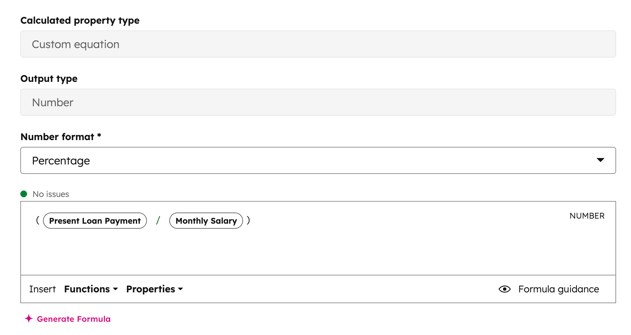
Using custom calculated properties and simple calculations, HubSpot automatically determines:
- The customer’s Debt Servicing Ratio
- Their remaining loan capacity
Step 3 – The financial snapshot appears in the CRM
![[Example] Loan Qualification Snapsot_HubSpot_engagent](https://www.engagent.io/hs-fs/hubfs/Engagent/Blog%20Images/%5BExample%5D%20Loan%20Qualification%20Snapsot_HubSpot_engagent.png?width=641&height=191&name=%5BExample%5D%20Loan%20Qualification%20Snapsot_HubSpot_engagent.png)
Once the form is submitted, the information is stored inside the contact record and displayed as a Client Loan Qualification Snapshot.
Sales representatives can immediately view the customer’s financial position.
Step 4 – The sales conversation starts with clarity
Instead of beginning the conversation with financial questions, sales representatives can immediately discuss vehicle options that align with the customer’s financial capacity.
Improving the Sales Conversation
When financial information is available upfront, the sales conversation becomes far more productive.
Sales representatives can focus on helping the customer find the right vehicle rather than gathering basic financial data.
The discussion can quickly shift towards:
- Suitable vehicle options
- Financing structures
- Possible down payment strategies
- Alternative vehicle models
For example, a representative might say:
“Based on the information you shared, your available loan capacity is approximately TT$4,700 per month. Let’s explore some vehicles that would comfortably fit within that range.”
This approach allows the conversation to start further along the buyer journey.
Using Automation to Support the Sales Process
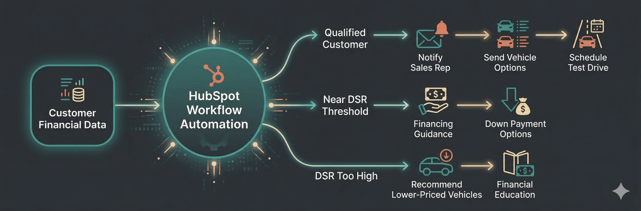
One of the biggest advantages of using HubSpot is the ability to automate actions based on the customer’s financial data.
Once the DSR and loan capacity are calculated, workflows can trigger different actions.
Examples include:
If the customer qualifies comfortably
- Notify the sales representative
- Send vehicle recommendations
- Invite the customer to schedule a test drive
If the customer is near the DSR limit
- Provide financing guidance
- Suggest higher down payments
- Offer consultation with a sales advisor
If the customer exceeds the recommended DSR
- send financial education resources
- recommend lower-priced vehicle options
- provide information about improving credit eligibility
Automation ensures that every lead receives the appropriate follow-up without requiring manual intervention.
Routing Leads to the Right Sales Team
Another strategic advantage of this approach is internal lead routing.
If a customer’s available loan capacity falls below the threshold for a new vehicle, HubSpot workflows can automatically:
- Assign the lead to the pre-owned vehicle sales team
- Notify a finance specialist
- Trigger alternative vehicle recommendations
This ensures that customers are directed to the most relevant solutions immediately.

Industry Applications Beyond Automotive
Although this example focuses on automotive sales, the same CRM strategy can be applied in other industries that rely on financial qualification.
Examples include:
- Credit unions assessing loan eligibility
- Banks evaluating financing requests
- Mortgage providers qualifying home buyers
- Real estate agencies assessing purchasing capacity
- Insurance companies evaluating coverage affordability
Any organisation that needs to assess financial capacity can benefit from integrating qualification logic directly into their CRM system.
CRM as a Strategic Sales Tool
Many companies still view CRM systems primarily as tools for storing customer data or tracking activities.
However, the real value of CRM lies in its ability to provide insight before the sales conversation begins.
By combining:
- Data capture
- Automated calculations
- Workflow automation
Businesses can transform their CRM into a system that actively supports sales teams.
Instead of simply recording conversations, the CRM becomes a tool that informs and improves them.

COMMENTS